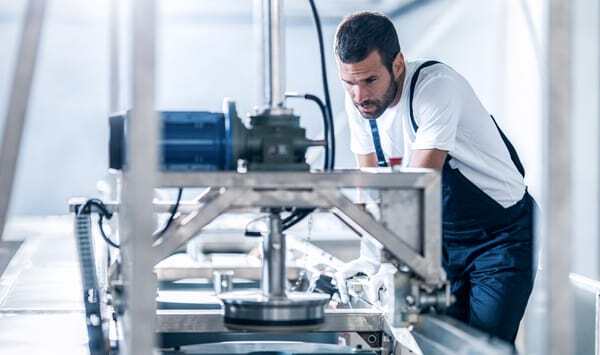
Mechanical engineering businesses are rarely short of demand. Instead, the challenge is often finding enough space, managing changing requirements and keeping production running smoothly. As product ranges become broader and batch sizes smaller, workshops and production support areas need to accommodate increasing quantities of tools, components and semi-finished parts without expanding their footprint.
Limited visibility of inventory can also create delays, with employees spending valuable time searching for parts that should be readily accessible.
With industrial space becoming increasingly valuable and skilled labour in short supply, vertical lift modules (VLMs) provide a practical way to improve storage capacity while supporting day-to-day production requirements.
Mechanical engineering storage challenges in a European context
Mechanical engineering and plant construction businesses can manage thousands of individual SKUs, ranging from cutting tools and measuring equipment to spare parts, components and assemblies. Traditional storage methods, such as static racking and cabinets, can take up considerable floor space around production areas while offering limited visibility of what is actually in stock.
For manufacturers across the UK and Europe, reducing lead times and minimising production downtime remain key priorities. Delays caused by unavailable or misplaced components can quickly affect productivity. At the same time, workplace health and safety regulations means businesses are looking for storage solutions that can support regulations, whilst also improving ergonomics and providing greater control over valuable or sensitive parts.
How VLMs support mechanical production storage
A VLM is an automated storage and retrieval system designed to make use of a building's vertical space. Trays are stored within the unit and automatically retrieved, with the required tray delivered to the operator at an ergonomic access point.
For mechanical engineering operations, this can help address several common storage and production challenges:
- Better use of available space, by storing tools, components and parts vertically rather than spreading them across a larger floor area.
- High-density storage, allowing products of different sizes to be accommodated within the same system.
- Greater picking accuracy, with guided retrieval and controlled access helping operators locate the correct items.
- Reduced travel time, as production and maintenance teams can access parts without walking lengthy aisles or using ladders. Items are brought to a consistent working height, supporting both efficiency and improved ergonomics.
Practical use cases on the shop floor
Within mechanical production environments, VLMs can be installed close to assembly lines, machining centres and other key production areas. Tools, consumables and components can be stored centrally and retrieved as required, helping to reduce clutter at point of use while providing a clearer view of available stock.
VLMs can also act as buffer storage between different stages of production. Semi-finished components can be temporarily stored and retrieved when required for the next process. This provides additional flexibility and can help production teams manage minor delays without bringing the entire line to a standstill.
For maintenance teams, automated storage can provide quick and traceable access to essential spare parts. When connected to warehouse management or ERP systems, VLMs can also support more accurate stock information and reorder points, helping businesses reduce the risk of unexpected parts shortages and downtime.
Beyond storage: supporting operational stability
The advantages of VLMs in mechanical engineering extend beyond creating additional storage space. By assigning standardised storage locations and controlling access, businesses can improve the management of high-value tools, components and equipment.
Enclosed storage can also provide a cleaner and more controlled environment for parts that need additional protection.
VLMs can offer flexibility as production requirements change. Tray configurations can be adjusted to accommodate different requirements, while additional systems can be introduced as storage needs grow. This allows businesses to adapt without undertaking major changes to the warehouse layout.
A measured step towards warehouse automation
For many mechanical engineering businesses, a vertical lift module provides an introduction to warehouse automation. A VLM can improve order fulfilment efficiency and picking accuracy without requiring a complete system overhaul.
Considering automation for mechanical production storage? A closer look at how vertical lift modules integrate into existing layouts can help clarify where automation adds the most value: An Automated Warehouse Made for You.