
MRO inventory is getting harder and harder to manage as manufacturers and service organizations support growing SKU counts, aging equipment, and faster service expectations. At the same time, the cost of operational downtime continues to rise:
According to the 2025 State of Manufacturing Maintenance Report, unplanned downtime costs Fortune 500 manufacturers an estimated $1.4 trillion annually, while the average manufacturer experiences roughly 800 hours of downtime per year. The report also found that the average cost of one hour of downtime has climbed to approximately $260,000 per hour.
For this reason, organizations are placing greater emphasis on spare parts availability and fulfillment speed.But managing MRO inventory is increasingly complex since many facilities support thousands of SKUs across fragmented storage locations while still needing immediate access to critical parts when equipment failures occur.
The challenge is no longer just storing inventory. It is about retrieving the right parts fast enough to keep operations running. Let's define and explore ways to optimize your MRO inventory!
What is MRO
MRO (Maintenance, Repair, and Operations) is a category of inventory that supports keeping equipment, facilities, and operations running. It usually consists of items like spare parts, bearings, gloves, tools, nuts and bolts, lubricants, and other operation-critical items.
While often grouped together, each component of MRO has different inventory behaviors and requirements.
Maintenance
Maintenance inventory supports scheduled activities like inspections and routine part replacement. While demand is more predictable, parts still need to be available at the right time to avoid delays and keep equipment running efficiently.
Repair
Repair inventory comes into play when something breaks. This can happen on the manufacturing line or out in the field, meaning that fulfillment or retrieval speed makes the difference in getting things up and running. Parts need to be available immediately through just-in-time workflows, will-call, or on-demand fulfillment.
Operations
Operations inventory includes consumables, tools, and everyday supplies. These items move more frequently, but they are typically less time sensitive.
MRO inventory shows up everywhere. Manufacturing facilities, distribution centers, equipment dealer networks, field service operations. Different environments, same core challenge:
Do we have the right parts, and can we access them when it actually matters?
What Is MRO Inventory Optimization
MRO inventory optimization is about making sure spare parts, tools, and maintenance supplies are available when needed without overstocking, wasting space, or slowing down operations.
Sounds straightforward. In reality, it isn't.
Unlike production inventory, MRO inventory behaves differently. Demand is unpredictable, SKU counts can be extremely high, and many items may sit idle for long periods but become critical in a moment. That is where most operations struggle.
In practice, most organizations aren’t struggling with whether they have the right parts. They’re struggling with whether they can find, access, and deliver those parts quickly enough to prevent downtime.
Why is MRO Inventory Optimization So Challenging?
MRO inventory is complex. Not just because of what types of SKUs are stored, but because of how it must be accessed and distributed across different channels.
High SKU Counts and Slow-Moving Inventory
MRO environments often manage tens of thousands of SKUs, including spare parts that may not move for months or even years, but they still must be immediately available when needed. Companies that sell, lease, or service heavy equipment, for example, must support equipment that is 20–25 years old while continuously adding new parts. What does this look like? Inventory keeps growing, space gets tighter, and complexity increases.
Fragmented Storage and Poor Accessibility
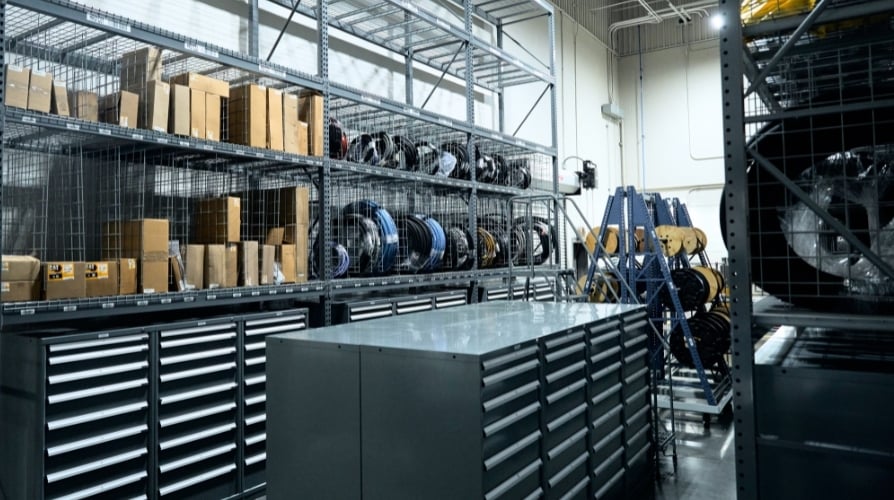
As inventory grows, you end up with a mix of drawers, shelving, and pallet locations, and inventory gets spread across multiple storage locations. As a result, operators spend more time walking and searching than actually picking.
Multi-Zone Picking and Order Consolidation
Because inventory is spread across multiple storage systems and zones, a single order may require picking from several locations. Then everything has to be manually consolidated which becomes a real bottleneck. Overall, the more zones and consolidation efforts that are needed means increased touchpoints, labor costs, and time.
Multiple Fulfillment Workflows with Competing Priorities
MRO operations rarely support a single workflow. Instead, they usually handle a combination of:
-
Will-call orders that need to be fulfilled immediately
- Distribution and replenishment orders
- Internal maintenance needs
Each of these workflows has different speed and priority requirements, but they all rely on the same inventory.
Without a coordinated system, this creates bottlenecks, delays, and inconsistent service levels.
Strategies for Effective MRO Inventory Optimization
Organizations use a range of strategies to improve MRO inventory performance. These approaches typically focus on improving organization, visibility, and control to ensure that the right parts are available when needed.
However, MRO optimization doesn’t stop at planning and tracking. It also depends on how efficiently inventory can be accessed and fulfilled in real-world operations.
Foundational Strategies
- Standardized labeling and bin locations
- Part numbering and cataloging systems
- 5S and general inventory organization
Control & Visibility Strategies
- Inventory classification (spare parts criticality , ABC analysis)
- Demand forecasting and safety stock optimization
- Supplier and vendor management
- Software integration for inventory tracking
- Dedicated inventory ownership or management
Execution & Fulfillment Strategies
- Optimizing storage layout and system design
- Streamlining workflows for distribution, replenishment, and will-call
- Implementing goods-to-person picking systems (i.e. AutoStore for MRO ops)
- Enabling order prioritization and on-demand retrieval
These approaches directly influence how efficiently inventory moves through your operation.
.jpg?width=1200&height=800&name=Kardex_img_customer_WEG_09-1200x800-5b2df79%20(1).jpg)
How Automated Storage Optimizes MRO Inventory
As MRO and spare parts operations grow, traditional storage methods start to break down. Drawers, shelving, pallet locations. They all add up to fragmented inventory and inefficient workflows.
So, what changes when we introduce automated storage? Below are a few key benefits of using automated storage for MRO and spare parts fulfillment.
-
Faster Access to Critical Spare Parts: We eliminate the need to search across multiple locations and sections of the warehouse. Parts come to the operator, which reduces delays in maintenance and repair workflows.
-
Accurate Inventory: We know exactly where parts are. That means no more situations where the system says something is in stock, but no one can find it.
-
Reduced Multi-Zone Picking: We minimize the need to pick parts across drawers, shelving, and pallet locations, eliminating manual consolidation before shipping (if applicable).
-
Better Management of Long-Tail Inventory: We can store slow-moving but essential parts for legacy equipment without consuming excessive space or losing accessibility.
-
On-Demand Picking: We can prioritize urgent requests and retrieve parts quickly for unplanned breakdowns.
-
Improved Throughput: We can support higher picking volumes for spare parts orders across centralized distribution and store replenishment operations.
-
Increased Picking Accuracy: When parts look almost identical, human-error happens. Automated systems brings the correct bin at the right time, significantly reducing picking errors.
-
Standardized Workflows: Creates consistent processes for retrieving and handling parts across MRO workflows.
-
Reduced Labor: We reduce walking, searching, and manual handling in MRO storerooms. This improves productivity in labor-constrained environments.
Automated Storage Solutions to Optimize MRO Inventory
So how do we actually achieve these benefits?
It comes down to using the right mix of integrated storage technologies that can support a variety of MRO spare part types, from small fasteners to heavy components, across a variety of workflows and movement patterns.
-
AutoStore – Best suited for high SKU counts, small spare parts where both storage density and throughput are critical. Support high-volume picking, distribution, and will-call workflows, with capabilities like on-demand picking and order prioritization. Learn more about how AutoStore is used in MRO operations.
-
Kardex Shuttle (VLM) – Designed for medium- and large- sized parts, tools, and irregular items, typically in the hundreds to a few thousand SKUs per unit. Ideal for environments where controlled access and moderate throughput are required. Learn more about Vertical Lift Modules.
-
Kardex Megamat (vertical carousel) - Effective for fast-moving small parts with frequent access requirements. Well-suited for applications that require quick operator access and consistent picking speed, but not large-scale throughput. Learn more about Vertical Carousel Modules.
While each of these solutions serves a different purpose, the real value comes from how they work together to support the full range of MRO inventory.
An integrated approach:
As MRO operations grow, SKU count, throughput, and storage requirements become more complex. Organizations must support high-SKU spare parts, long-tail inventory, fast-moving items, and time-sensitive workflows.
So instead of thinking about individual systems, or trying to find one technology that solves everything, we need to think about how they fit together.
- High-density systems manage large volumes of small parts
- Vertical systems support mixed sizes and irregular items
- Carousel systems enable fast access to frequently used components
Then we connect everything.
Software plays a critical role in connecting these systems. Kardex software coordinates workflows across all of its storage solutions, enabling capabilities such as order prioritization and on-demand picking. This ensures urgent requests (i.e. will-call orders) can be fulfilled quickly without disrupting ongoing operations.
Over time, these solutions operate as a single system, combining storage, software, and workflow logic into a cohesive, scalable MRO operation that can support virtually any spare parts requirement.
How Can I Start Optimizing My MRO Inventory?
Start by understanding how inventory is currently stored, accessed, and distributed. From there, determine whether your operation should focus first on foundational improvements, inventory control and visibility, or fulfillment execution strategies.
Identify where parts are difficult to locate, where workflows are fragmented, and where storage space is underutilized.
Once those challenges are clear, the next step is simplifying operations — and this is often where opportunities for storage automation, workflow optimization, and system integration become more apparent.
If you're ready to explore how automated storage solutions can help optimize your fulfillment strategy, send us a message.
