

Warehouse inventory management depends on a fundamental operating reality: the stock recorded in your system must match the stock actually available in each location. When it does not, the effects ripple through the operation, from wasted search time and failed picks to urgent purchases, expedited freight, and missed customer commitments. All these issues come with direct, tangible costs, and will only become worse when trying to manage inventory amid disruption. That’s why, in our survey of 100+ warehouse leaders, 62.3% of respondents identified inventory control as a top warehouse challenge..
This article examines why inventory discrepancies develop and how strategies like location discipline, cycle counting, access controls, traceability, and automation can help warehouses maintain accurate records and accountable inventory movement.
What Is Inventory Control? (and How It Differs from Inventory Management)
While broader warehouse management best practices guide decisions about how inventory should support the operation, inventory control protects the accuracy of the stock records those decisions rely on. That requires consistent control over every receipt, putaway, move, pick, and adjustment.
Specifically, inventory management encompasses planning decisions such as what to stock, how much to carry, and when to replenish it. Inventory control focuses on execution inside the warehouse, whether each item is:
- Placed in its recorded location
- Available in the recorded quantity and condition
- Traceable as it moves through the operation.
Learn about how inventory control fits into the bigger picture in our Inventory Management Guide.

Signs Your Inventory Control Is Slipping
Inventory control problems typically become visible through recurring operational disruptions such as:
- Inventory discrepancies: Physical counts routinely differ from system records.
- Failed cycle counts: The same SKUs or locations repeatedly require reconciliation.
- Unexplained shrinkage: Inventory disappears through errors, damage, or unauthorized removal.
- Poor traceability: Teams cannot determine where an item went, when it moved, or who handled it.
- Urgent purchasing and expediting: Stock shown as available cannot be found or used, forcing costly replacement orders.
“We visited a customer recently whose inventory costs had skyrocketed. They were making urgent spot purchases for items they thought were in stock but were actually obsolete. Between the rush buys and the expedited freight, their handling costs had gone up fivefold.”
Jeff Peters
Regional Business Director, Kardex Remstar

Why Inventory Control Breaks Down
Inventory control rarely breaks down because of one major failure. More often, small gaps accumulate over-time: a receipt is entered late, an item is placed in a temporary location, a move goes undocumented, or inventory is accessed without a clear record of who handled it.
At lower volumes, experienced employees may compensate through memory and informal communication. As SKU counts, order volumes, and staffing demands increase, however, those workarounds become harder to sustain. Manual data entry creates more opportunities for error, location rules become more difficult to enforce, and irregular counting allows discrepancies to persist. Whether the problem begins with a gap in the process or a solid process pushed beyond its limits, the result is the same: physical inventory and system records gradually drift apart.
Because these issues will only become more apparent as operations scale, warehouse teams will always benefit from moving proactively to:
- Solve any apparent inventory control issues (however small) before they spiral out of control.
- Establish best practices that will systematically prevent these errors from recurring.

How to Improve Inventory Accuracy Without Adding Headcount
Each of the practices above can strengthen inventory control, yet each also places new demands on the team. More frequent counts, tighter verification, better documentation, and closer discrepancy review all take time in an operation where employees already have full workloads.
The logic behind ABC classification illustrates the necessary balance: control effort must be prioritized, not simply expanded. Warehouses need to apply the greatest scrutiny where errors carry the greatest consequences. Prioritization alone, however, does not eliminate the workload. Improving accuracy without adding headcount also requires reducing the friction involved in maintaining control, from capturing inventory activity as it happens to identifying exceptions without broad manual reviews.
For lean warehouse teams, the objective is to make essential control practices easier to execute within the time and capacity already available. Well-designed processes and supporting automation technology can help employees spend less time searching, recounting, correcting records, and expediting missing stock, leaving more time to maintain accurate inventory as part of the normal workflow.
How Automation Strengthens Inventory Control
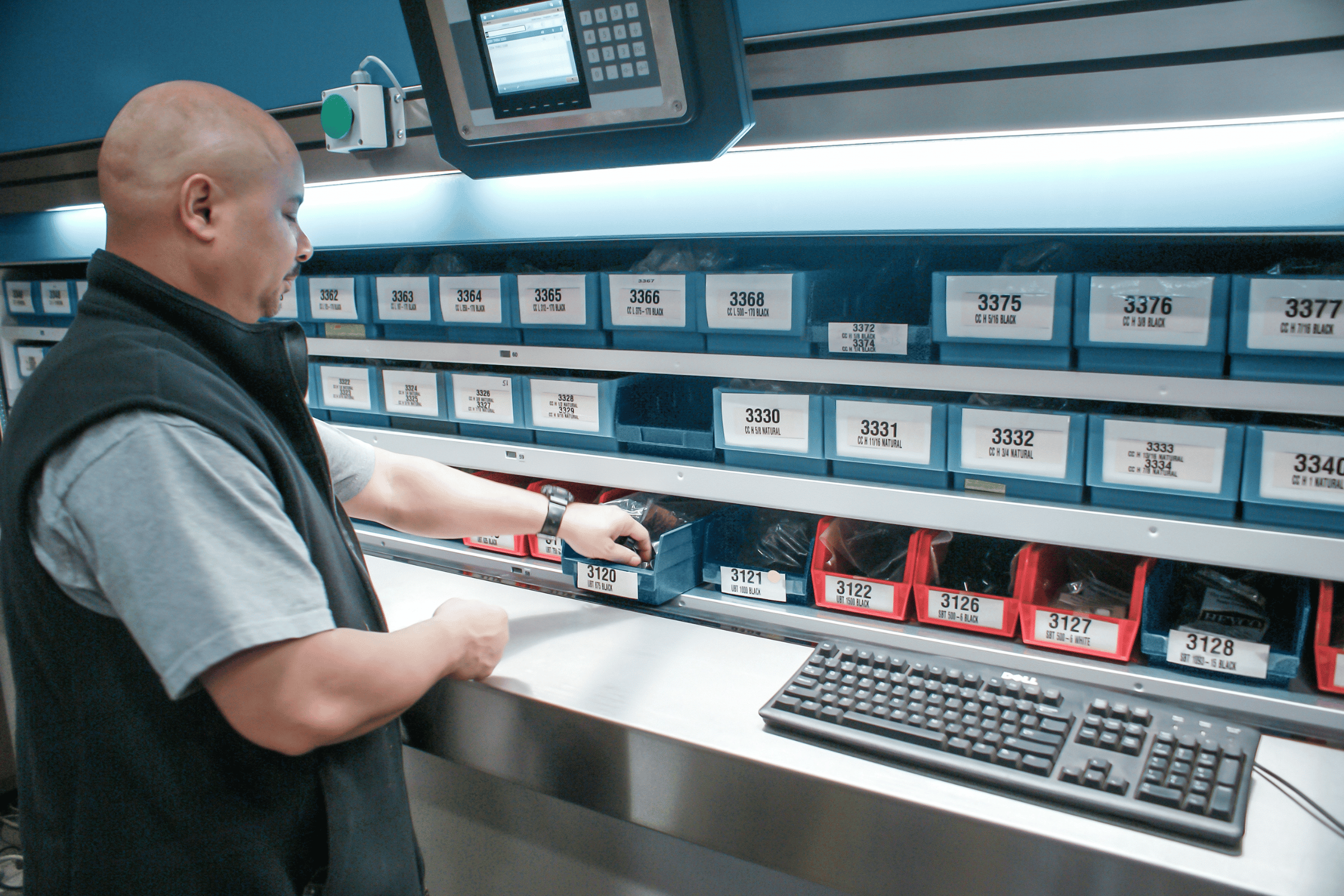
An automated storage and retrieval system (ASRS) combines enclosed storage, software-directed inventory locations, and automated retrieval. Instead of employees searching open shelving or moving freely between storage locations, the system delivers the required inventory to a controlled access point.
This structure reinforces inventory control in several important ways:
- Physical access is limited
- Unnecessary handling is reduced
- The system maintains a defined location for every stored item.
When the ASRS is paired with inventory management software (see below), receipts, picks, returns, and adjustments can be recorded as they occur and associated with an individual user. Pick-to-light and other guidance tools further support accuracy by directing employees to the correct item and quantity. These capabilities show exactly why automation does not replace sound inventory practices, but makes those practices easier to enforce consistently.
The right ASRS can support picking accuracy of up to 99.99%.
For example, when FlightSafety International, a leading flight simulator manufacturer, replaced open shelving with four Kardex Shuttle Vertical Lift Modules (VLMs) supported by Kardex Power Pick System and light-directed picking, the flight simulator manufacturer increased inventory accuracy from the mid-90% range to 99.9%. Employees previously needed in the stockroom were reassigned to other areas of the warehouse, while the automated process reduced the storage footprint by 85%.
Learn more about FlightSafety International’s inventory control success story.
“The improvement customers don’t expect is process time. Something that took four hours gets done in one; a job that needed four people now takes two. The walking, bending, reaching, and climbing all go away.”
Jeff Peters
Regional Business Director, Kardex Remstar
How Software Sustains Control Over Time
Automated storage creates a controlled physical environment, while inventory management software preserves the record of what happens within it. By directing and documenting inventory activity as it occurs, software helps prevent the gradual loss of accuracy that can develop through undocumented movements, inconsistent handling, and disconnected records.
Kardex Power Pick System supports this ongoing control through capabilities such as:
- Lot and serial number tracking: Maintains traceability for specific batches or individual items through storage and retrieval.
- FIFO management: Directs employees to retrieve older inventory first when stock rotation matters.
- User- and role-based access: Limits available functions according to employee responsibilities and associates activity with individual users.
- Transaction audit trails: Records picks, returns, receipts, and adjustments so teams can reconstruct inventory movement and investigate discrepancies.
- Reporting: Provides visibility into inventory levels, activity, and transaction history to support review and corrective action.
Together, these capabilities turn inventory control into a continuous, documented process rather than a periodic effort to restore accuracy after records have drifted.
See how inventory software supports traceability and control with Kardex Power Pick

Strengthen Inventory Control One Process at a Time
Inventory control is maintained through daily execution. Clear locations, timely transactions, consistent counting, controlled access, and discrepancy review establish the foundation. Automation and software can then make those practices easier to enforce as inventory volume and operational complexity grow.
For a closer look at one of the most important control practices, explore our guide to cycle counting in the warehouse.
For warehouses considering automation, Kardex can help assess current inventory-control processes, identify where automation may add value, and arrange a visit to an existing customer site so managers and employees can see the system operating in a real warehouse. As Jeff Peters, Regional Business Director at Kardex Remstar, explains:
“The biggest worry is the same one everybody has: change. How will employees react? Will they miss the old way? That’s exactly why we bring prospects to see a system running at an existing customer’s site.”
Jeff Peters
Regional Business Director, Kardex Remstar
Talk with a Kardex specialist to evaluate your inventory-control needs and see how other warehouse teams have successfully made the transition.

