Differences Between AutoStore and Shuttles
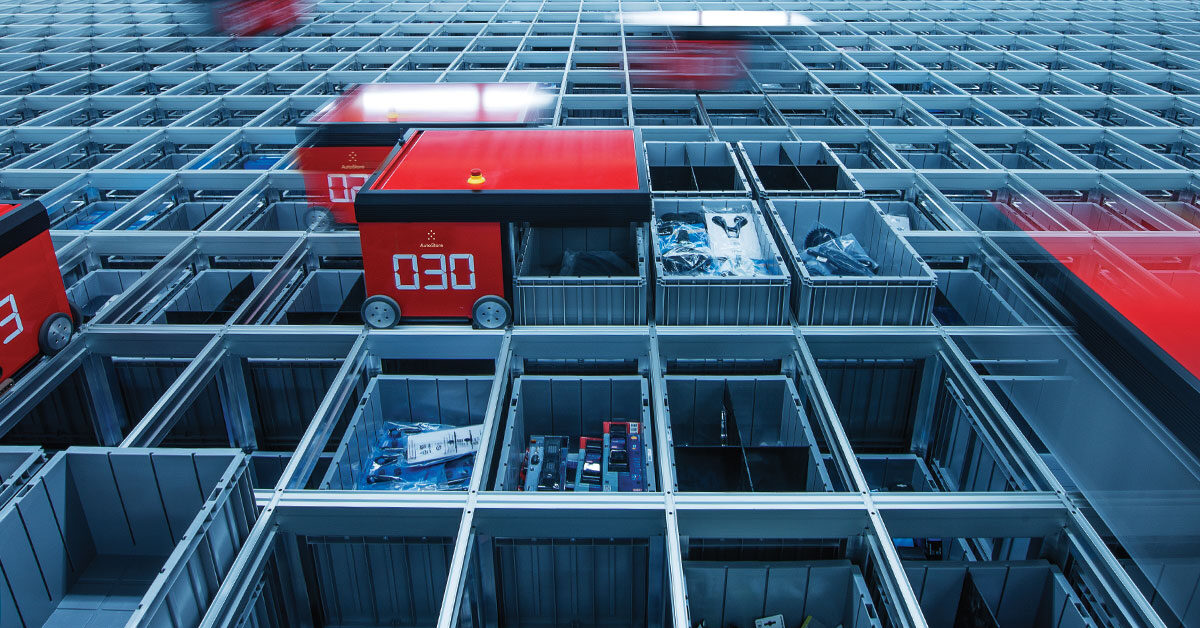
AutoStore is a robotic cube-based ASRS that employs a grid-based system where robots move on top of a storage grid and drop down within the grid columns to access and pick-up bins that are stacked directly on top of one another.
If you're not familiar with AutoStore, here's a deep dive on how AutoStore works.
Traditional shuttle systems such as case shuttles and multi-shuttles use aisles with shuttles running horizontally to retrieve cartons, bins, trays, or a combination of all.

Storage Density and Space Utilization
The case shuttle system is adept at accommodating cases and larger products efficiently.
In buildings with clear heights less than 40 feet, it may struggle to match the density of AutoStore due to AutoStore bins stacking directly atop each other, eliminating air gaps. However, in structures exceeding 40 feet in height, the case shuttle excels in density, surpassing AutoStore.
While case shuttle systems provide pretty good density compared to other technologies, they require a significant investment in light goods conveyors in addition to the multi-shuttle system. It's important to note that despite their high throughput, multi-shuttle systems may require in-rack sprinkler systems per fire regulations, which can impact the overall space utilization of the system.
Speed and Throughput
Case shuttle systems traditionally boast higher throughput rates, however, recent technological advancements from AutoStore (i.e. AutoCase, CarouselAI) and Kardex (i.e Kardex FulfillX, Intuitive Picking Assistant) have closed this throughput gap. In fact, in a recent AutoStore project, Kardex achieved 13,100 bin presentations per hour.
Watch the AutoStore case study featuring 13,000 bin presentations per hour.
As a result, businesses evaluating warehouse automation solutions now find themselves with a more balanced choice between the two systems, where considerations beyond throughput, such as space utilization and system flexibility, may play a more significant role in decision-making.
Storage Variety & Capacity
AutoStore offers an advantage in maximizing storage density and efficiency for facilities dealing with a high volume of small SKUs.
Additionally, Kardex can combine AutoStore with an existing Kardex Vertical Lift Module (VLM), all controlled through a single software platform. This hybrid approach allows operations to store both small parts (in AutoStore) and large, bulky items (in a Kardex VLM) within one unified system and workflow. It creates a more flexible storage ecosystem without forcing you to choose between technologies.
While case shuttle systems can handle a wider variety of product sizes, including large and bulky items, AutoStore's reliance on standardized bin optimizes space utilization and simplifies inventory management. This design allows AutoStore to achieve significantly higher storage capacity within a compact footprint.
Reliability & Redundancy
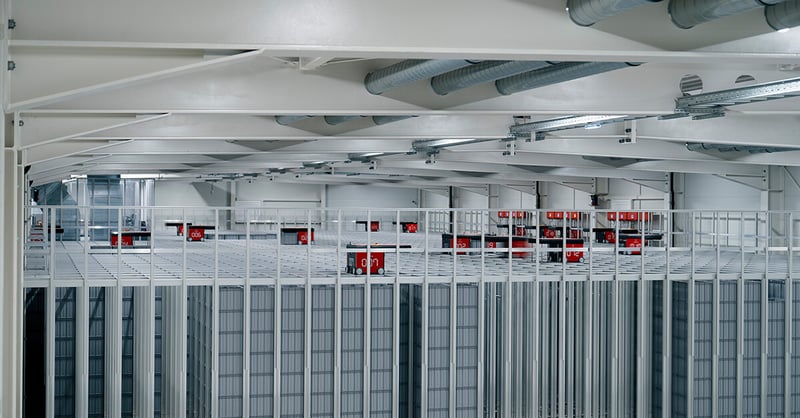
In an AutoStore system, if any single robot or port encounters a malfunction, the rest of the system remains operational, ensuring uninterrupted warehouse operations. Conversely, in a case shuttle system, if an aisle goes down due to maintenance or repair any aspect of that aisle (ie., shuttle), all inventory within that aisle becomes inaccessible until the issue is resolved.
To mitigate this risk, case shuttle systems require inventory to be mirrored across multiple aisles, necessitating the duplication of stock to safeguard against disruptions in accessibility. This mitigation technique requires more storage locations, means more equipment costs and more floorspace.
Conversely, AutoStore eliminates the need for mirrored inventory, offering a more streamlined and efficient solution for maintaining reliability and minimizing downtime within warehouse operations. Inventory is able to be transported by any robot within the AutoStore system and be delivered to any port, meaning full redundancy of the system without the need for additional storage locations for mirrored inventory.
Cost Comparison: AutoStore vs Shuttles
Initial Investment
For most facilities, AutoStore offers a stronger return on investment. Its lower implementation costs, high throughput, superior density, and built-in redundancy make it a cost-effective solution for operations seeking speed without the heavier infrastructure requirements of shuttle systems.
Here's everything you need to know about how much AutoStore costs.
However, in ultra-high throughput scenarios with simple pick tasks, shuttle systems can offer a faster payback period despite their higher initial investment. The enhanced efficiency and productivity of shuttle systems in handling large volumes of orders quickly can lead to significant operational savings and revenue generation, thereby offsetting the initial costs more rapidly.
Total Cost of Ownership Factors
The total cost of ownership (TCO) of robotic automated storage and retrieval systems (ASRS) includes several factors beyond the initial purchase price. Key factors that play into the TCO are:
- Initial capital investment: This includes the cost of the robotic ASRS equipment itself, such as robots, bins, shuttles, conveyors, and supporting infrastructure.
- Installation and Integration: Costs associated with installing the system, integrating it with existing warehouse management systems (WMS), and any necessary facility modifications.
- Maintenance and Repairs: Ongoing costs for regular maintenance, repairs, and replacement parts to keep the system running efficiently.
- Energy Consumption: The cost of electricity required to operate the system, which can vary based on the efficiency of the equipment and the frequency of use.
- Software and Licensing: Expenses related to software required to operate and manage the system, including initial licensing fees and ongoing software updates or subscriptions.
- Training and Labor: Costs for training employees to operate and maintain the system, as well as any labor costs for ongoing system management and troubleshooting.
- Space Utilization: The efficiency of space utilization can impact the overall cost, as more efficient systems may reduce the need for additional storage space, potentially lowering facility costs.
- Downtime and Reliability: The impact of system reliability on operational continuity, including potential costs associated with downtime or reduced productivity during maintenance or repairs.
- Scalability and Flexibility: The ability to scale and adapt the system to changing business needs without significant additional investment.
- Depreciation and Lifecycle: The anticipated lifespan of the system and how it depreciates over time, which affects long-term financial planning and replacement costs.
- Insurance and Compliance: Costs related to insuring the system and ensuring it complies with relevant regulations and safety standards. This includes the cost of the robotic ASRS equipment itself, such as robots, bins, shuttles, conveyors, and supporting infrastructure.
Use Cases: When to Choose AutoStore or Shuttles
When deciding between implementing an AutoStore system or a case shuttle system in your warehouse facility, consider all of the following factors:
Throughput Requirements:
- AutoStore: Comparable to shuttle-level throughput in most use cases.
- Case Shuttle: Still excel in ultra-high-speed, ultra-simple pick environments.
Product Variety and Size:
- AutoStore: Small to medium-sized items stored. Kardex can combine AutoStore with a VLM or VCM to support larger items in the same system.
- Case Shuttle: Capable of handling larger, bulkier items and a wide range of product sizes.
Initial Investment:
- AutoStore: Generally lower initial costs.
- Case Shuttle: Higher initial costs but justified in buildings taller than 40 feet.
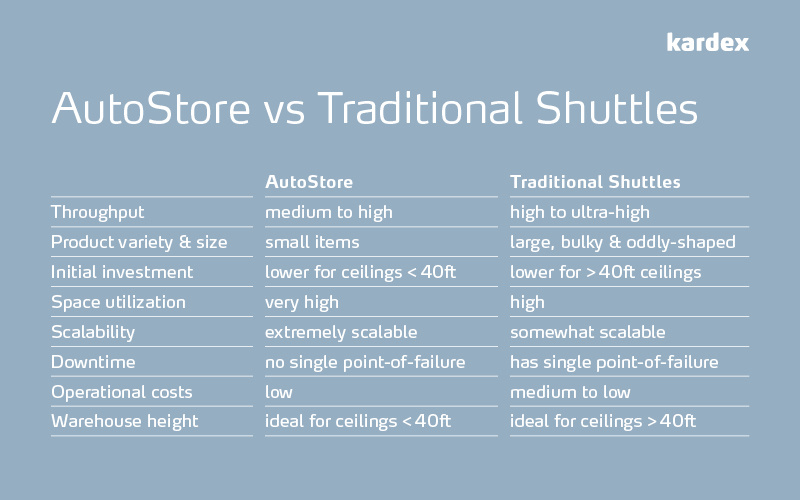
Space Utilization:
- AutoStore: Excellent density with no air gaps between bins, optimizing vertical space up to a certain height.
- Case Shuttle: Requires more vertical space, with potential gaps for sprinklers, but can outperform in taller buildings.
Reliability and Redundancy:
- AutoStore: High reliability with system redundancy; individual robot or port failures do not halt operations.
- Case Shuttle: Less redundancy; aisle failures can disrupt access to inventory unless mirrored stock is maintained.
Scalability:
- AutoStore: Modular and easily scalable to adjust to changing needs.
- Case Shuttle: Scalability can be more complex and costly due to infrastructure requirements.
Maintenance and Downtime:
- AutoStore: Typically lower maintenance and downtime due to fewer moving parts.
- Case Shuttle: Requires more maintenance and can experience significant downtime if an aisle goes down.
Operational Costs:
- AutoStore: Lower ongoing operational costs due to energy efficiency and reduced need for mirrored inventory.
- Case Shuttle: Higher operational costs, particularly if mirrored inventory is necessary for reliability.
Warehouse Height:
- AutoStore: Optimal in facilities with lower ceiling heights and remains the most dense solution in building with clear height under 40ft.
- Case Shuttle: More advantageous in warehouses with higher ceilings, typically over 40 feet.
Ideal Applications for AutoStore
When recommending AutoStore over shuttle systems, industries or warehouse scenarios with medium throughput and a focus on handling smaller parts are ideal candidates.
- Retail / general merchandise
- Small parts fulfillment
- Kitting and assembly processes
- Limited warehouse space
- High SKU variety
- Automation-first operations
- Case or carton handling

AutoStore excels in efficiently managing inventory with medium to very high throughput levels, making it well-suited for order fulfillment of light industrial manufacturing components, hardware pieces, plumbing supplies, sensors, electrical components, and items of similar size.
Common products stored in AutoStore Systems
- Light industrial manufacturing supplies
- Hardware components
- Plumbing supplies & valves
- Electrical components & sensors
- Medical devices for kitting
- Automotive parts & pieces
- Apparel
- Beauty supplies
Any sector that requires the kitting and assembly of small parts can benefit from AutoStore's precision and organization. Conversely, shuttle systems may be more appropriate for industries dealing with larger items or requiring very high throughput, where the size and weight of products demand a different approach to storage and retrieval.
Ideal Applications for Shuttle Systems
- Bulk handling
- Case or carton handling
- Very high throughput requirements
- Fast, simple picking tasks
- Building taller than 40 feet
Making the Right Choice for Your Business
Above are some factors to consider, however each business case is unique and has special requirements.
To better understand the differences between AutoStore and other shuttle systems, contact an automation expert.