
Tangible warehouse improvement can begin with a simple question: where can we make meaningful gains without waiting for a full redesign or a future automation project? For many operations, the answer lies in practical changes that improve how space is used, how inventory is organized, and how work moves through the facility day to day.
This article outlines ten warehouse improvement ideas that can help address common operational pain points now, from SKU slotting to picking accuracy, inventory control, and labor efficiency.
These best practices can drive immediate improvements while helping build a strong foundation for a strategic automation program.
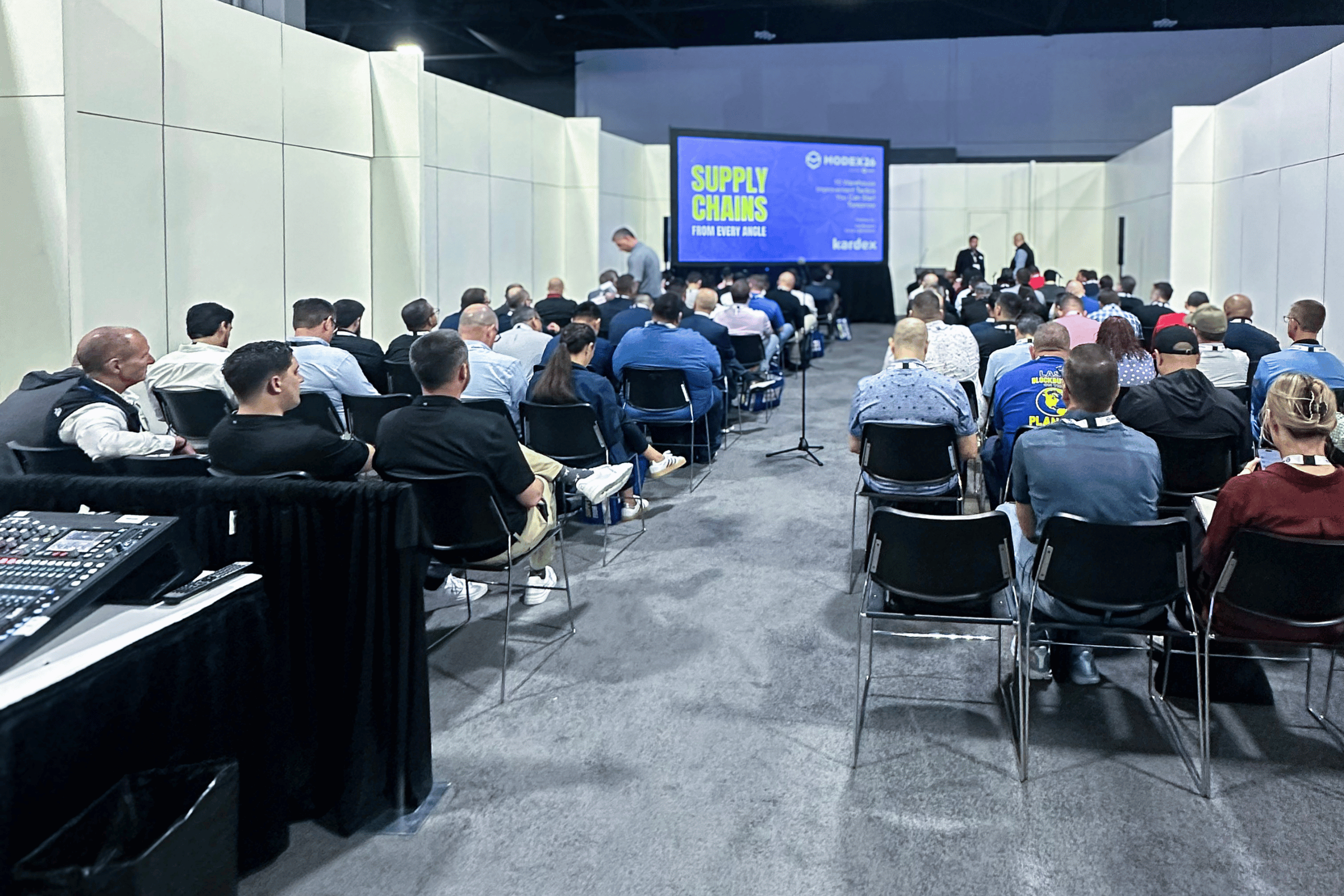
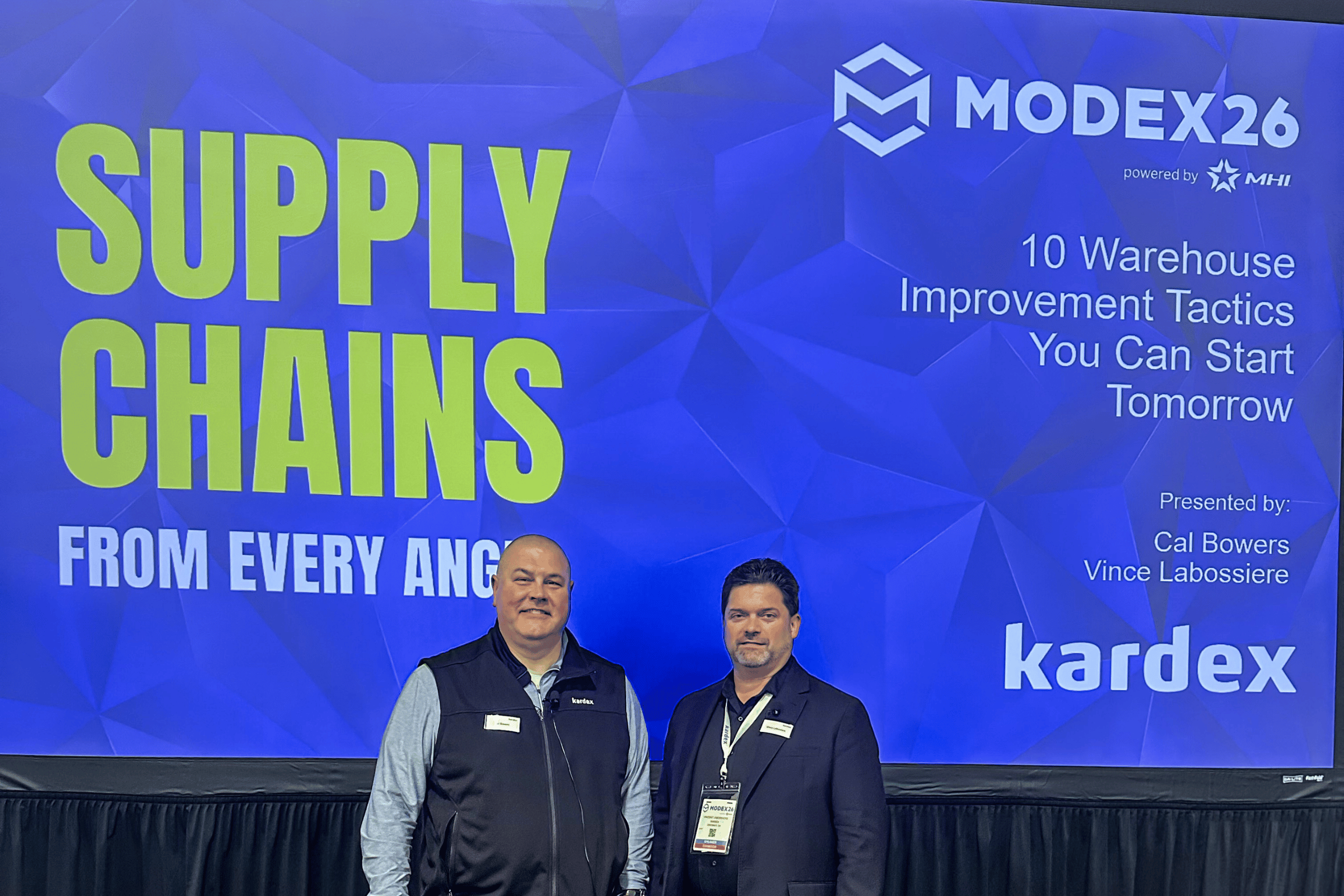
This article is based on the seminar presented at MODEX 2026 titled: 10 Warehouse Improvement Tactics You can Start Tomorrow. Presented by Cal Bowers and Vince Labossiere of Kardex.
How to Start Identifying Warehouse Process Improvements
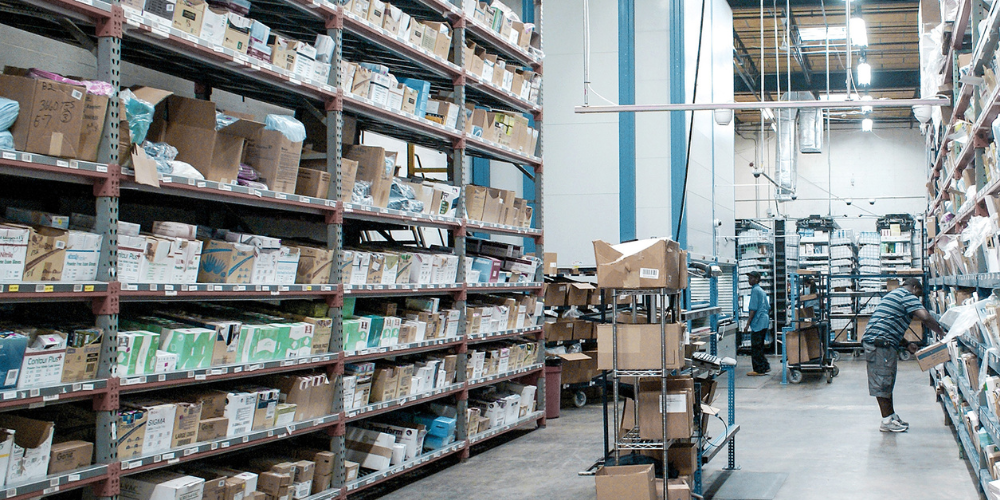
The easiest way to start identifying warehouse process improvements is to start with floor-level pain points. In most facilities, inefficiencies show up in the daily friction that slows work down, creates unnecessary labor, or makes it harder to scale existing processes.
Common examples include:
- Pickers spending too much time walking to and from storage locations
- Overflow inventory taking up valuable floor space
- Congestion in picking, staging, or replenishment zones
- Frequent mispicks or order accuracy issues
- Inventory discrepancies that create delays and rework
- Returns building up without a clearly defined process
- Peak periods putting too much strain on labor and throughput
Once those issues are clearly identified, the next step is to assess which problems can be solved with process changes alone, and which may eventually justify further automation.
This balance is a key theme in almost any warehouse optimization initiative. Automation can deliver major operational benefits, from reducing travel time and improving accuracy to increasing storage density and making labor more productive. But it is most effective when applied to the right targets. In the wrong area, or too early, unnecessary automation can simply add cost and complexity without addressing the root problem.
Warehouse Optimization as a Foundation for Warehouse Automation
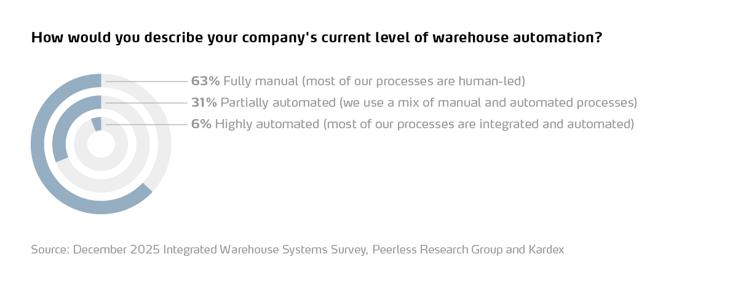
The potential benefits of automation may be recognized by most warehouse managers, but the reality on the floor is that most operations are still relying heavily on manual labor, manual travel, and manual decision-making. According to the December 2025 Integrated Warehouse Systems Survey from Peerless Research Group and Kardex:
- 63% of respondents described their facilities as fully manual
- 31% said they were partially automated
- 6% said their operations were highly automated.
Even among companies planning to automate, implementation often happens on a long timeline or remains subject to operational uncertainty.
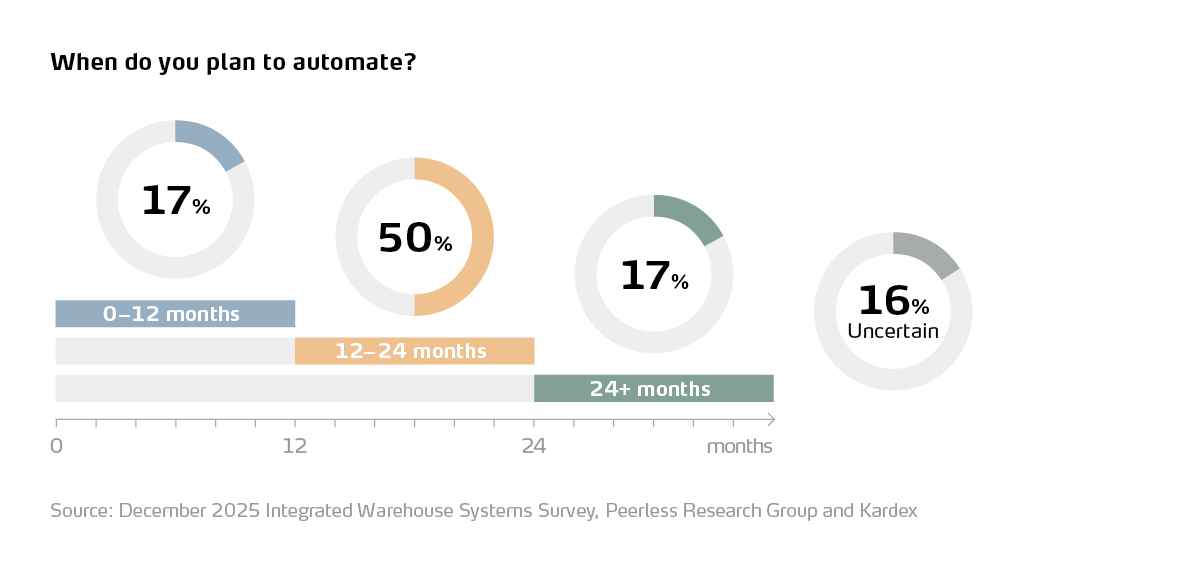
For this reason, the warehouse improvement ideas outlined below are designed to help facilities act on current pain points today. Each one focuses on practical warehouse optimizations that can deliver value in the near term while developing a more scalable, automated warehouse over time.
Click below to get access to the complete slide deck:

Idea One: Maximize Space Utilization
Space constraints are often one of the first signs that a warehouse has room to improve, and a few straightforward changes can make existing space work harder.
- Storing products of similar height on the same shelf helps reduce wasted vertical gaps and creates more usable storage space overall.
- Subdividing storage bins can also improve shelf utilization, especially for smaller parts or mixed inventory that would otherwise leave partially used locations.
- It is also worth looking at whether the full depth of existing racking or shelving is actually being used effectively, rather than leaving valuable storage cube underutilized.
Vertical storage is another key option to consider.
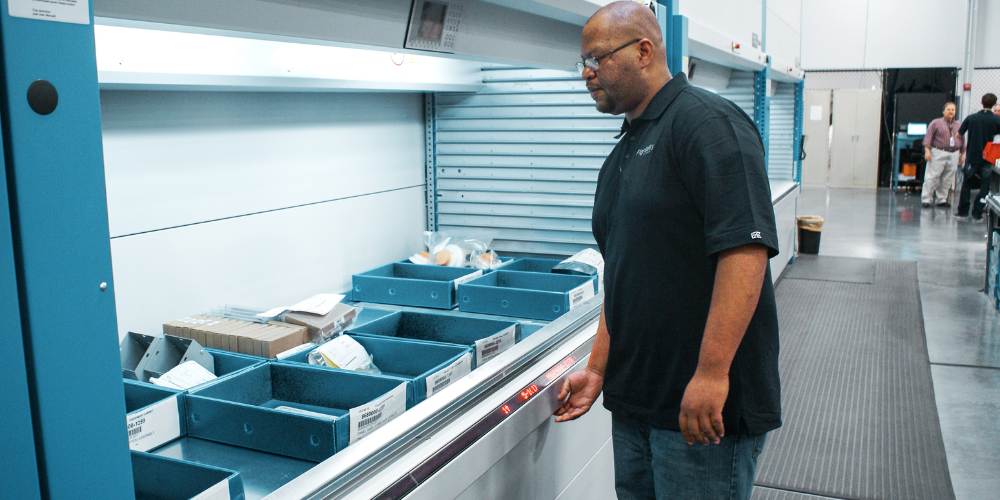
Vertical lift modules, or VLMs, are automated storage systems that use the full height of a facility to store inventory more densely and deliver it to an access opening. For operations trying to improve space utilization, that approach can immediately free up space while creating more long-term flexibility: instead of continuing to expand into additional floor space as operations scale, warehouses expand their storage vertically as needed.
Idea Two: Improve Slotting for Faster Access
SKU slotting has a direct impact on picking speed, travel time, and labor efficiency. Even in a well-organized warehouse, poor slotting slows down access to high-demand inventory and creates unnecessary movement throughout the day.
Start by making sure fast-moving, high-priority SKUs are stored in the most accessible locations, especially near the end of aisles and around waist height where they can be reached quickly and safely. It also helps to store items that are frequently picked together in the same area or as a pre-defined kit, reducing the number of separate touches required to complete an order.
Because demand patterns change, slotting should not be treated as a one-time setup. Reviewing slotting logic on a quarterly basis will help ensure inventory placement still reflects actual order activity and product velocity.
Learn more in our guide to warehouse slotting strategies and best practices.

Idea Three: Enhance Labor Efficiency
Labor efficiency is directly impacted by the structure of the warehouse environment. When aisles are cluttered, inventory is difficult to access, or processes are unclear, even experienced teams are forced to work more slowly and with greater effort (and possibly even with greater ergonomic and safety risk).
- Clearing aisles of unnecessary materials is a simple but important first step. Open, unobstructed paths make it easier to move quickly and safely throughout the facility.
- Organizing product so it is easy to locate and retrieve reduces time spent searching or repositioning items during picking and replenishment.
- Clear signage and consistent labeling also play a critical role, helping workers navigate the warehouse and stay accurate.
There is also a strong ergonomic component to labor efficiency. Investing in solutions that reduce bending, reaching, and repetitive strain can improve both productivity and consistency.
Over time, these changes help teams maintain performance throughout a shift while reducing fatigue and the risk of errors.
Idea Four: Streamline Picking Processes
One of the most effective ways to streamline picking is to ensure the facility follows a clear, one-directional flow. This principle helps reduce backtracking, congestion, and confusion during high-volume periods.
Minimizing the number of times a product is handled is also key. Each additional touch adds time and increases the potential for error, so processes should be designed to move items efficiently from storage to packing with as few steps as possible.
Tracking movement can also provide valuable insight. Using tools like pedometers or wearable tracking devices can help quantify how much time workers spend walking versus picking, making it easier to identify opportunities to reduce unnecessary travel.
Finally, picking directly into a shipper container can eliminate intermediate steps in the process. By reducing the need to transfer items between bins or staging areas, operations can move orders through the system more quickly while improving overall efficiency.
Printable PDF Checklist
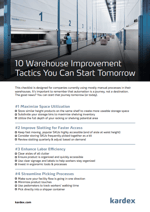
Want to take these ideas to go? Download a printable PDF checklist now.
This checklist was presented at MODEX 2026 and is available for instant download for you to print and take around your warehouse floor.
Start improving your warehouse today! Download Checklist
Idea Five: Boost Picking Accuracy
As your warehouse works to streamline its picking process, maintaining picking accuracy will be critical to staying efficient: errors create rework, delay shipments, and often lead to costly returns, making accuracy improvements one of the highest-impact areas for many warehouses.
Technology can play an important role here. Barcode scanning helps ensure that the correct items are picked and put away by verifying each step in the process. Additionally, weighing outbound orders can help catch discrepancies before shipment, especially for high-volume or multi-line orders.
Certain process optimizations can also make an impact. For example, adding a second verification step for certain orders can significantly reduce mispicks, particularly in complex or high-value shipments. For personnel, aligning performance incentives with accuracy, not just speed, helps reinforce the right behaviors across the team.
For operations looking to go further, systems like pick-to-light, pick-to-voice, and wearable task technologies can guide workers through the picking process in real time. These tools help reduce reliance on memory and paper-based instructions, improving consistency and making it easier to maintain high accuracy even as order volume increases.
Idea Six: Implement More Precise Inventory Control
Unreliable inventory data leads directly to downstream issues across picking, replenishment, and order fulfillment, often forcing teams to rely on workarounds that slow the operation down.
At a high-level, regular cycle counting is one of the most effective ways to maintain accurate inventory levels without disrupting daily workflows. Instead of relying solely on full physical counts, ongoing cycle counts help identify discrepancies early and keep inventory records aligned with reality. Establishing minimum reorder quantities can also improve consistency.
Inventory handling processes should be another key focus area. Clear procedures for receiving, putaway, and replenishment will help reduce errors. As operations grow, these processes should be revisited to ensure they can scale with increasing volume and complexity.
Idea Seven: Strengthen Returns Management
Returns are often one of the least structured areas of warehouse operations, but they can quickly become a source of inefficiency if not managed carefully.
Start by establishing a documented returns process that defines how items are received, inspected, and re-entered into inventory. This will support consistency and reduces reliance on ad hoc decisions. Designating a specific returns area is also important, as keeping returns separate from forward inventory helps avoid cross-contamination.
Learn more about opportunities to go further in our whitepaper on automated returns management.
Idea Eight: Protect High Value Inventory
Without clear safeguards in place, high-value inventory items are more vulnerable to loss, misplacement, or unauthorized access, all of which can have an outsized financial impact.
- Start by securing high-value items in locked storage areas with appropriate camera visibility. This creates a controlled environment where access can be monitored and restricted to authorized personnel.
- Scan-based verification can further strengthen control by requiring users to log access and movement, creating a clear record of who handled specific items and when.
- For operations with particularly sensitive or high-cost inventory, RFID can provide an additional layer of tracking. By enabling real-time visibility into item location and movement, RFID helps reduce reliance on manual checks and makes it easier to quickly identify discrepancies or unusual activity.

Idea Nine: Build Flexible Processes for Peaks
Peak periods put pressure on every part of the warehouse, and even well-run operations can struggle to keep up with demand spikes, leading to delays, errors, and increased labor strain.
Designing the warehouse with flexibility in mind is a key first step. Layouts and workflows should allow for adjustments in how work is distributed, whether that means shifting picking zones, reallocating space for staging, or temporarily changing flow paths to handle higher volume.
Cross-training employees is equally important. When workers can move between picking, packing, replenishment, and other functions, operations can respond more effectively to changing workloads without needing to rely entirely on adding more labor.
Finally, more advanced picking strategies can also help balance throughput during peak periods. Approaches like zone picking, batch picking, or wave picking can be adjusted based on order volume and mix, helping maintain efficiency even as demand fluctuates.
We take a deeper look at these approaches and more in our in-depth guide to warehouse picking methods.
Idea Ten: Create an Automation Strategy That Builds on These Warehouse Efficiency Ideas
Automation is most effective when it is built on a clear understanding of where the operation is losing time, space, and accuracy.
- Rather than starting with a specific technology, the process should begin by identifying the most impactful pain points and addressing those first. This helps ensure that any investment is tied directly to measurable operational gains and the fastest possible return.
- Establishing clear KPIs before implementing automation is another indispensable best practice. Metrics for picking speed, accuracy, space utilization, and labor productivity are needed to provide a baseline for improvement and make it easier to evaluate whether new systems are delivering the expected results.
For many operations, the best approach is to start with simple, well-defined automation that solves a specific problem. Systems like vertical lift modules (VLMs) can improve storage density and reduce travel time by bringing inventory directly to the operator. When applied to the right use case, this type of targeted automation can deliver immediate benefits without requiring a full warehouse redesign (and while still retaining the possibility to integrate additional automated solutions in the future).
Finally, the right software approach will be important for any deeper automation. A warehouse management system (WMS) or similar platform helps coordinate inventory, workflows, and automation technologies, ensuring that improvements are integrated into a cohesive approach.
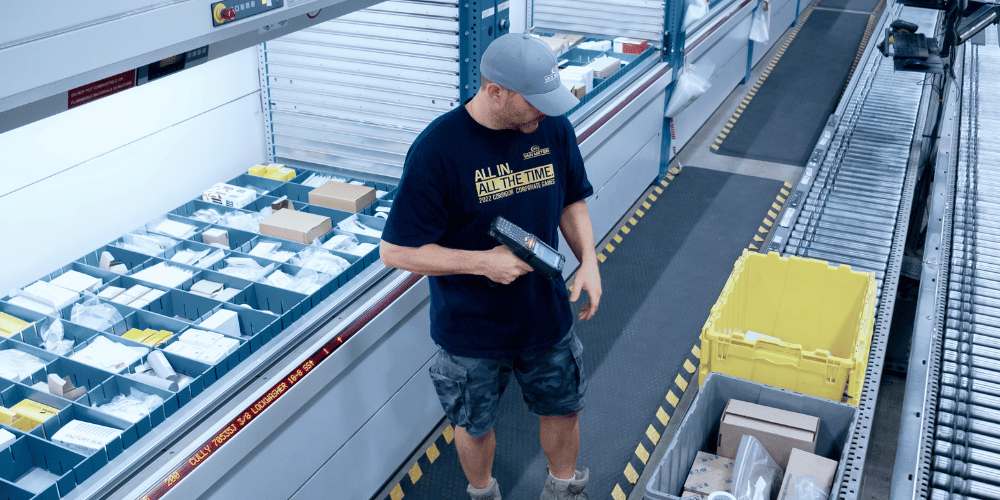
For a deeper look at the full breadth of potential warehouse automation solutions (like Vertical Carousel Modules, conveyors, scanners, and more), explore our Complete Guide to Warehouse Automation in 2026.
Ready to get started with your warehouse improvement plan?
Improving warehouse performance starts with understanding where inefficiencies exist and identifying the right tools to address them. Whether the goal is to optimize space, improve picking efficiency, or begin building toward automation, the right strategy can make a measurable impact on day-to-day operations.
Explore how different storage and automation approaches can support your warehouse improvement goals, or connect with a specialist to discuss the best path forward for your facility.
