
When we talk to customers who rely on modular drawer cabinets, they often tell us about a tool room that’s packed. They’ve got full cabinets, drawers that won't close, and no room to grow. If this scenario sounds familiar, it’s time to assess the best way to expand your storage.
Modular drawer cabinets are a solid solution in small doses. They’re organized, secure, and easy to justify when you need a few drawers for a lab bench or a small tool crib. But before you go that route, ask yourself, is there a better way to maximize my warehouse space, not just now, but for the future?
Once you reach the scale of 15 or more cabinets, it’s time to look at using a Vertical Lift Module (VLM) or Vertical Carousel Module (VCM).
A single Kardex VLM or VCM can replace 26 to 84 modular drawer cabinets, depending on your ceiling height, and free up 54% to 86% of the floor space those cabinets would occupy. All while improving ergonomics for your team and setting you up for future automation.
This article shows you where drawer cabinets make sense, where they become a liability, and how to quickly evaluate whether an automated storage system is the smarter investment for your operation.
What are Modular Drawer Cabinets?
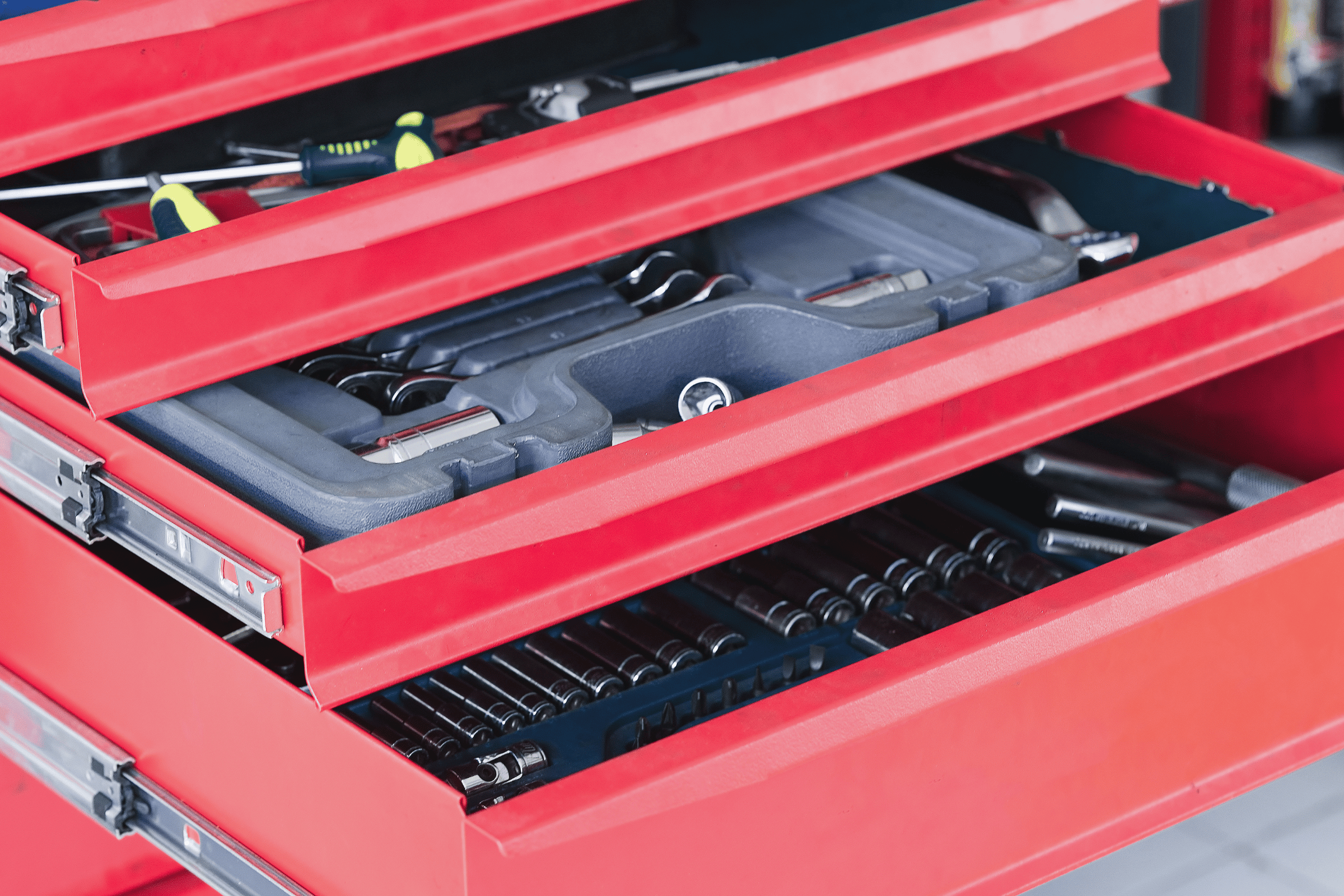
Modular drawer cabinets are freestanding steel storage units with adjustable drawers sized for small parts. They’re a staple in tool cribs, MRO storerooms, manufacturing cells, and maintenance departments across virtually every industry.
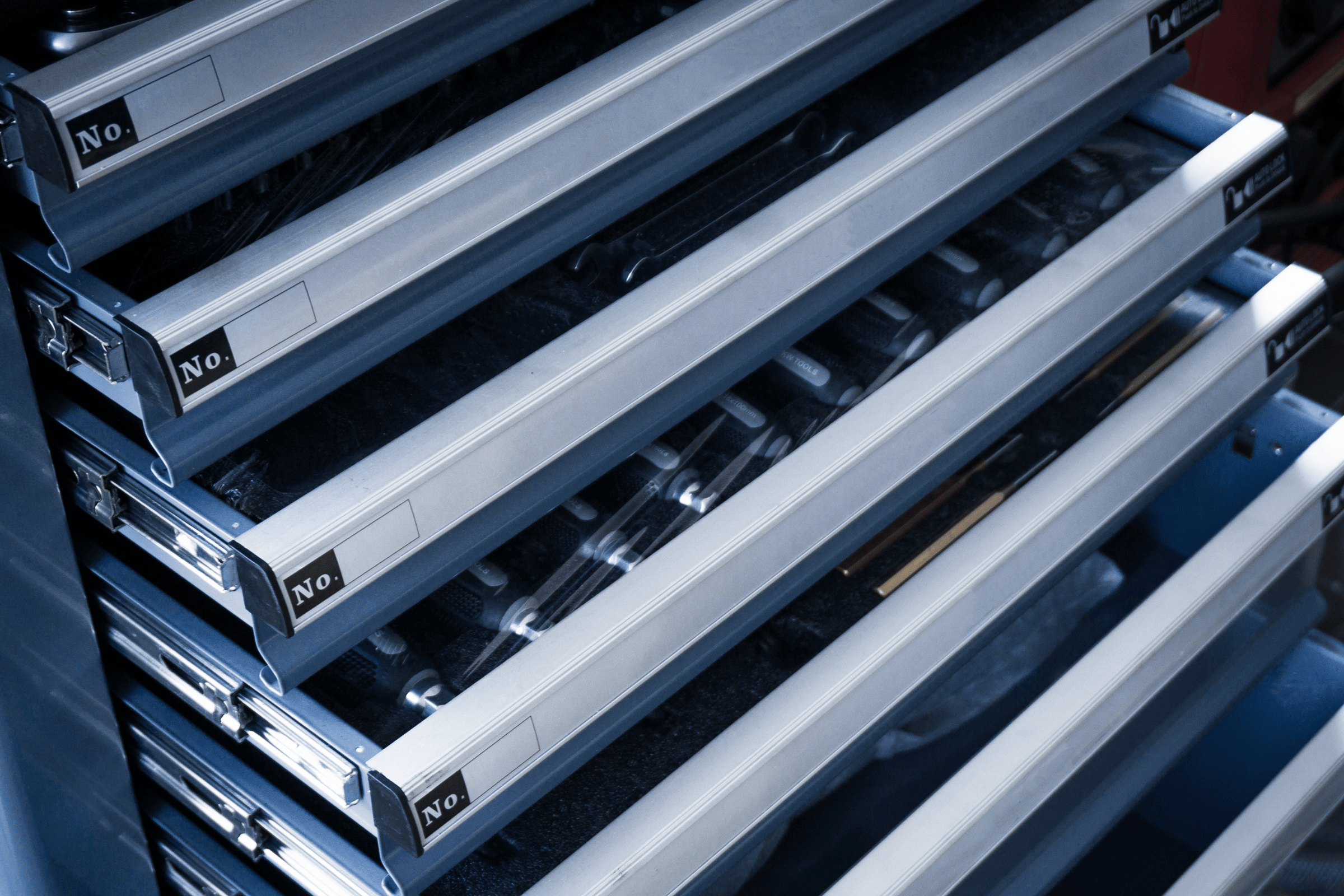
They work well because they’re:
- Familiar and easy to use with minimal training
- Configurable with adjustable dividers for various part sizes
- Secure with lockable drawers and key control
- Affordable upfront for low-volume storage needs
- Practical in spaces with low ceilings or limited SKUs
For a lab, a small maintenance room, or a team managing a tight range of parts, a bank of modular drawers is a practical choice.
The problem comes when you start adding more.
What Is Automated Storage and Retrieval?
Automated storage and retrieval systems, or ASRS, use software and machine-controlled storage equipment to bring items to an operator instead of requiring workers to walk aisles or search shelves. In this article, the most relevant ASRS options are the Vertical Lift Module (VLM) and Vertical Carousel Module (VCM), both of which use vertical space to store inventory more densely than modular drawer cabinets.
Vertical Lift Module (VLM)
.png?width=1200&height=628&name=USNR_ASRS_Automated_Manufacturing_ShuttleXP_03-1200x628-a0aa05d_FeaturedImage%20(2).png)
A Vertical Lift Module (VLM) stores items on trays inside an enclosed unit and automatically delivers the requested tray to an ergonomic access opening. It is a strong fit for operations that need flexible storage for a wide range of item sizes and changing inventory profiles.
Vertical Carousel Module (VCM)
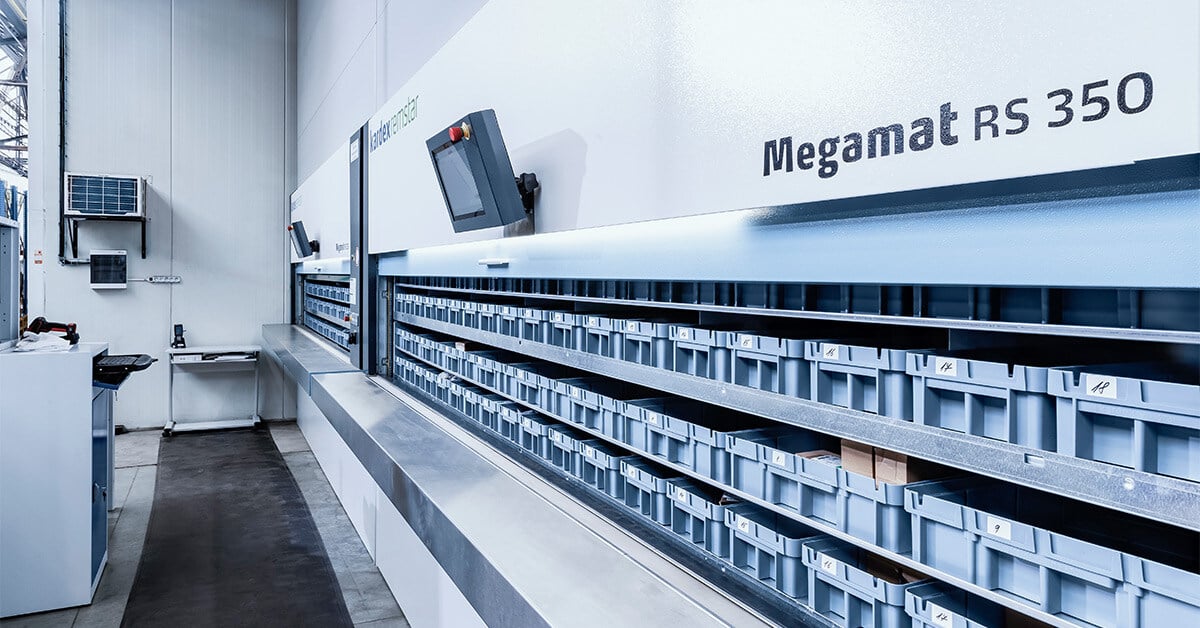
A Vertical Carousel Module (VCM) stores items on carriers that rotate vertically to bring the correct shelf to the operator. It is often a good fit for predictable small-parts storage where high-density organization and fast access are priorities.
Modular Drawer Cabinets vs Automated Vertical Storage Systems
The fundamental issue with modular drawer cabinets is that they grow sideways. Every time you run out of capacity, you add another cabinet. Eventually, you’re walking through a maze of steel to find a single part and your floorspace is gone.
A standard modular drawer cabinet has a footprint of roughly 25 x 25 inches and stands about 60 inches tall. A VLM or VCM, by comparison, occupies approximately 80 square feet of floor space but uses your full ceiling height to maximize capacity.
Here's how industrial drawer cabinets compare to automated vertical storage when it comes to space savings:
| Ceiling Height | Eliminated Drawer Cabinets | Approx Floor Space Required for Cabinets | Space Savings with Kardex Automated Storage | Space Savings (Percentage) |
| 15' | 26 | 260 | 140 | 54% |
| 20' | 36 | 360 | 240 | 67% |
| 25' | 48 | 480 | 360 | 75% |
| 30' | 62 | 620 | 500 | 81% |
| 35' | 74 | 740 | 620 | 84% |
| 40' | 84 | 840 | 720 | 86% |
NOTE: All numbers are approximate and assume that the Vertical Lift Module or Vertical Carousel Module will occupy approximately 80 square feet of floor space, and that modular drawer cabinets measure 25"x25"x60".
What does this mean for your operations and capacity for saving floor space?
At 20 feet, one Kardex unit replaces 36 cabinets and frees up 67% of that cabinet footprint.
At 30 feet, you’re reclaiming 81% of your floor. VLMs offer a fundamentally different way to think about storage density.
Beyond floor space, there are meaningful operational differences between static drawer storage and automated storage retrieval systems, like VLMs and VCMs. Here’s how they compare across the dimensions that matter most to warehouse and operations managers:
|
Modular Drawer Cabinets |
Kardex Shuttle VLM |
Kardex Megamat VCM |
|
|
Floor Space / Footprint |
Spreads across many sq ft |
~80 sq ft for entire unit |
~80 sq ft for entire unit |
|
Use of Vertical Height |
Stops at 5 ft; air above is wasted |
Utilizes full ceiling height |
Utilizes full ceiling height |
|
Capacity per Sq Ft |
Low |
Very high |
Very high |
|
Operator Ergonomics |
Walking, bending, reaching |
Goods delivered to ergonomic height |
Goods delivered to ergonomic height |
|
Inventory Control |
Paper-based or basic labeling |
Integrated software |
Integrated software |
|
Security & Access Logging |
Basic locks; no audit trail |
User-level access control + logs |
User-level access control + logs |
|
Inventory Weight Handling |
Good for small, dense parts |
Can handle thousands of pounds per tray |
Can handle thousands of pounds per carrier |
|
Scalability |
Add more cabinets (more floor space) |
Add trays, height, or units |
Add height, or units |
|
Future Automation Potential |
Very limited |
WMS integration, light-directed picking |
WMS integration, light-directed picking |
Drawer cabinets can be an effective, but static solution.
Pickers and operators walk to the parts. And scaling your storage means a larger footprint and even more walking and searching.
For dense inventory such as tooling, fixtures, spare parts, or high-count specialty materials, weight capacity matters just as much as storage volume.
Vertical Lift Modules and Vertical Carousel Modules offer immediate improvements to efficiency and ergonomics as you grow. The parts come directly to your workers, tracked and logged by your integrated software.
Did you know: You can set up your Vertical Lift Module to take a photo of the tool tray each time it's accessed. This image is then stored in a separate drive for your team. So you know exactly who accessed what tool, and when. When tools go 'missing', it's incredibly easy to back-track to see the last time it was on the tray.
How to Compare Modular Cabinets vs Automated Vertical Storage for Your Operation
Any changes to your storage system needs a careful cost analysis. Here are some things to consider as you evaluate future storage options.
1. Remember: Your Floor Space Isn’t Free
Whether you’re in a new facility or an existing one, every square foot of floor space carries a cost: construction, taxes, utilities, insurance, and security. Kardex systems are specifically designed to reduce those costs by building up instead of out. In new facilities, that can mean building a smaller footprint from the start. In existing facilities, it means reclaiming space you can put to better use, such as additional workstations, staging areas, or new equipment.
2. Analyze Your Equipment Costs Over Time
Ten cabinets today. Five more next year. Another six the year after that.
Modular drawer systems tend to grow incrementally and before long, you’ve invested substantially in a system you’ve outgrown anyway. A VLM or VCM is a larger upfront investment, but it’s one that consolidates your capacity, grows vertically rather than horizontally, and doesn’t require you to keep buying more.
As the number of cabinets grows, the cost gap can narrow faster than many teams expect.
Once you are pricing 10 to 15 modular drawer cabinets, it is worth comparing that investment against a Vertical Lift Module (VLM) or Vertical Carousel Module (VCM), especially when you also consider the floor space those cabinets consume. For a broader look at pricing considerations, read our guide to ASRS Cost Factors here.
3. Keep Your Eyes on Labor and Ergonomics
Drawer cabinets require your team to walk the room, bend to lower drawers, reach to upper ones, and search manually. That adds up. VLMs and VCMs bring every item to the operator at an ergonomic working height, eliminating unnecessary movement and reducing the physical strain that contributes to workplace injuries.
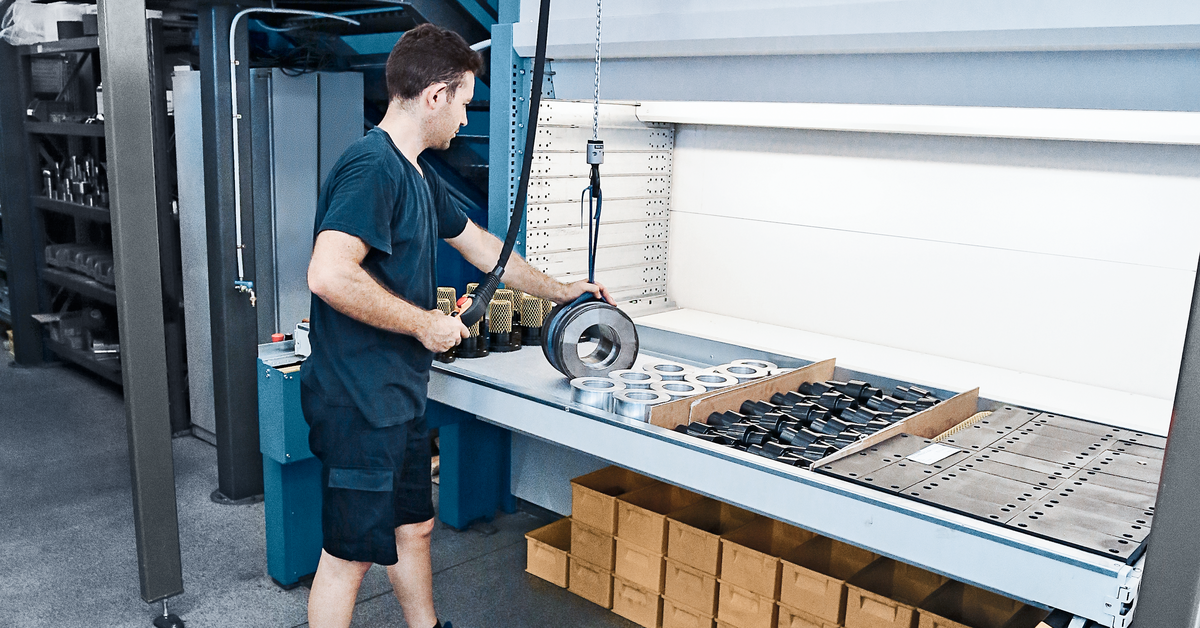
Vertical Lift Modules can handle thousands of pounds per tray. And they're ideal for warehouses looking to store a mix of inventory spanning a variety of sizes and weights. Vertical Carousels are ideal for small-to-medium sized inventory, including heavier secured loads.
Both can be integrated with material handling technology, like automated extractors, cranes, and forklifts, to make heavy handling easier on your team. So you can think beyond what you currently store in your modular cabinets, and start consolidating your rack shelving as well.
4. Analyze Your Inventory Accuracy and Shrinkage
Manual drawer systems rely on your team to pull the right part from the right drawer every time. Automated systems with integrated software and pick-to-light guidance dramatically reduce mispicks and make inventory shrinkage much harder to hide. Every transaction is logged and every user is tracked.
5. Solve for Future Growth and Flexibility
Cabinets lock you into a layout. When you grow, you add cabinets and lose more floor. VLMs and VCMs can be reslotted as your SKU mix changes, expanded vertically if ceiling height allows, or supplemented with additional units — without reorganizing your entire storage area.
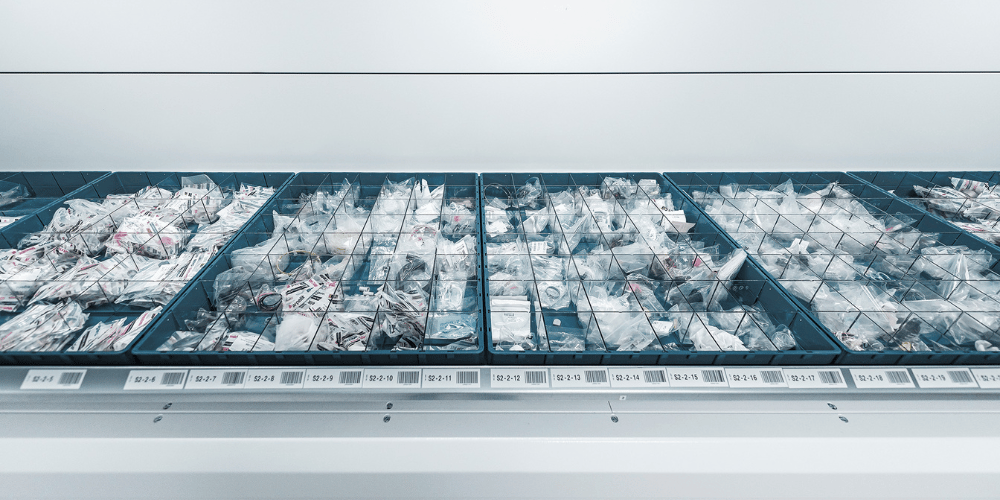
The opportunity also goes beyond replacing drawer cabinets alone. In many facilities, a Vertical Lift Module (VLM) or Vertical Carousel Module (VCM) can also absorb nearby shelving, overflow bins, and other small parts storage into the same footprint, helping teams consolidate more inventory while using full ceiling height.
The Long and Short of It:
If you’re planning more than 15 modular drawer cabinets in a space with at least 15 feet of clear ceiling height, you should get a VLM or VCM quote before you place that order. The comparison might surprise you.
Use the 15-cabinet threshold as a starting point, not a limit.
In many cases, the business case improves even more when you include adjacent shelving and overflow storage that could be consolidated into the same system.
Sometimes, it may even make sense to use these two technologies together.
It's Easy to Build an Automated Tool Crib
Modular drawer cabinets are a common choice for tool cribs because they keep tooling, gauges, holders, inserts, and spare parts organized in a compact footprint.
But as tool inventories grow and more users need access, the limits of a manual cabinet-based setup become easier to see.
In tool crib environments, the decision is not only about how much can be stored. It is also about who can access tools, how quickly items can be retrieved, and how accurately usage can be tracked. That is where a VLM or VCM can offer more value than modular drawer cabinets alone.
.jpg?width=1000&height=667&name=Kardex_img_customer_USNR_12%20(1).jpg)
By storing tools vertically, an automated system can reduce floor space requirements while improving organization and retrieval consistency. It can also create a more secure, controlled environment for high-value tooling that would otherwise be spread across drawers, shelving, or cage storage.
For manufacturers looking at tooling storage specifically, automated storage can also be part of a broader tool crib strategy with software-driven access, tracking, and accountability. For a deeper look, read our article on how to build an automated tool crib.
Automated Vertical Tool Storage in Action
In more advanced tool crib applications, automated storage can also integrate with tool management software to improve visibility and control. For example, Kardex solutions can support tool crib workflows that require secure access, digital transaction records, and tighter lifecycle management for high-value tooling, including integrations with platforms such as ZOLLER Tool Management Software.
How To Compare Your Drawer Plan to A VLM or VCM
You don’t need a lot of data to start this evaluation. Here’s a five-step process you can do in an afternoon:
- Count your current and planned drawer cabinets and note their combined footprint
- Measure the clear ceiling height in your target storage area
- Use the table above to estimate how many cabinets a single VLM or VCM could replace at your ceiling height
- Think about what you’d do with the freed floor space: workstations, staging, new equipment, or simply avoiding a facility expansion
- Send that information to Kardex for a quick layout concept and estimate - the comparison is free and usually eye-opening
Next Steps: Talk To Us Before You Buy More Cabinets
If you’re pricing out a bank of modular drawer cabinets right now, why not examine all your options? We’re happy to quickly provide you the numbers you need to make an educated decision. Give us a call, share your cabinet count, your room dimensions, and a rough description of what you’re storing. We’ll put together a simple, no-obligation comparison: here’s what your cabinet plan looks like vs. one or two Kardex units.
You might stick with cabinets. For some applications, that’s still the right answer. But if you’re approaching the point where storage is becoming a floor plan problem, it’s worth getting all the numbers before you commit.
Ready to compare? Contact Kardex today.
Explore the Kardex Shuttle VLM
Frequently Asked Questions
Are modular drawer cabinets cheaper than a VLM or VCM?
In small quantities, modular drawer cabinets usually have a lower upfront cost. But as the number of cabinets grows, the total investment can begin to approach a Vertical Lift Module (VLM) or Vertical Carousel Module (VCM), especially when you also consider floor space, efficiency, and future growth.
How many modular drawer cabinets can a VLM replace?
It depends on item size, weight, tray configuration, and ceiling height. As a general rule, if you are planning for more than 15 modular drawer cabinets and have at least 15 feet of clear ceiling height, it is worth evaluating a Vertical Lift Module (VLM) or Vertical Carousel Module (VCM).
What do warehouses store in modular drawer cabinets?
Warehouses and manufacturing facilities commonly use modular drawer cabinets to store tooling, spare parts, fasteners, gauges, fixtures, hardware, and other dense small- to medium-sized inventory that needs to stay organized, protected, and easy to access.
Can a VLM or VCM store more than tooling?
Yes. A Vertical Lift Module (VLM) or Vertical Carousel Module (VCM) can store tooling, spare parts, components, hardware, gauges, fixtures, and other small- to medium-sized goods. In many facilities, that makes it possible to consolidate not only drawer cabinets, but also nearby shelving and overflow storage.
Can automated storage be used as a tool crib?
Yes. Automated storage is often a strong fit for tool crib applications because it improves storage density, organization, access control, and retrieval speed. When paired with tool management software, it can also support better accountability and visibility into tool usage.
When do modular drawer cabinets still make sense?
Modular drawer cabinets are often the right fit for smaller storage needs, lower ceilings, or applications where automation and software-based inventory control are not priorities. They are a practical option when inventory is limited, access is simple, and growth is not expected.

