

|
4X Throughput |
30% More Storage Capacity
|
Future-Proofed Growth |
| Picking rates increased from 50 to 200 order lines per hour | Storage capacity increased by 30% while occupying only 10% of warehouse space. | Fulfilment operations scaled without expanding or relocating its facility. |
Case at a Glance
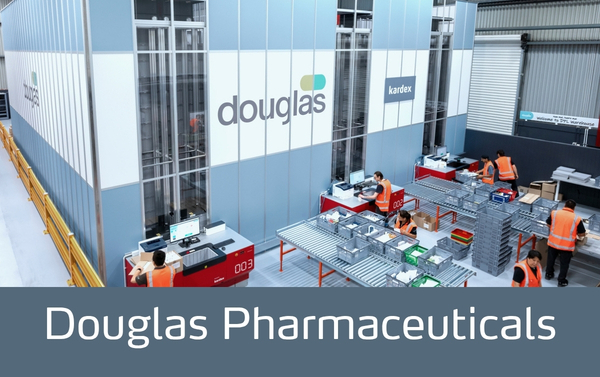
Douglas Pharmaceuticals implemented New Zealand’s first AutoStore™ goods-to-person system at its West Auckland campus to support growing inventory volumes while improving warehouse efficiency and fulfilment performance without relocating or expanding its facility.
As demand increased across retail, wholesale, and direct-to-consumer channels, Douglas required a scalable solution capable of increasing storage density, improving picking speed, and supporting long-term business growth. Working closely with Kardex, the company deployed a high-density AutoStore system supported by Kardex integration expertise.
The solution improved operational throughput by 68%, increased storage capacity by 30%, and enabled Douglas to process 3,000 order lines per day while maintaining high accuracy and operational reliability.
Scaling inventory in existing facilities
Customer and Task
Founded in 1967, Douglas Pharmaceuticals is New Zealand’s largest privately-owned pharmaceutical and nutraceutical company. The company manufactures, distributes, and supplies prescription medicines alongside a broad portfolio of health and wellness products.
As demand continued to grow, Douglas’ warehouse operations in West Auckland began reaching storage capacity limits. Existing manual processes created increasing pressure on space utilization, picking performance, and operational scalability.
The company needed a solution that could support future growth while improving warehouse efficiency within the current facility footprint.
Douglas evaluated multiple options, including expanding the existing warehouse and purchasing a separate storage facility. However, both approaches involved significant costs and operational complexities. Instead, the company selected warehouse automation through AutoStore empowered by Kardex as the most scalable and efficient long-term solution.
Several operational challenges were driving the need for automation:
-
- Growing inventory volumes creating pressure on available warehouse space
-
- Manual picking limitations restricting throughput and efficiency
-
- Increasing order volumes across retail, wholesale, and DTC operations
-
- Limited space for physical warehouse expansion
-
- The need for higher accuracy, traceability, and operational control
-
- Long-term growth targets requiring scalable fulfilment infrastructure
- The Solution
-
- Douglas partnered with Kardex to implement New Zealand’s first AutoStore automated storage and retrieval system (ASRS) at its Auckland headquarters.
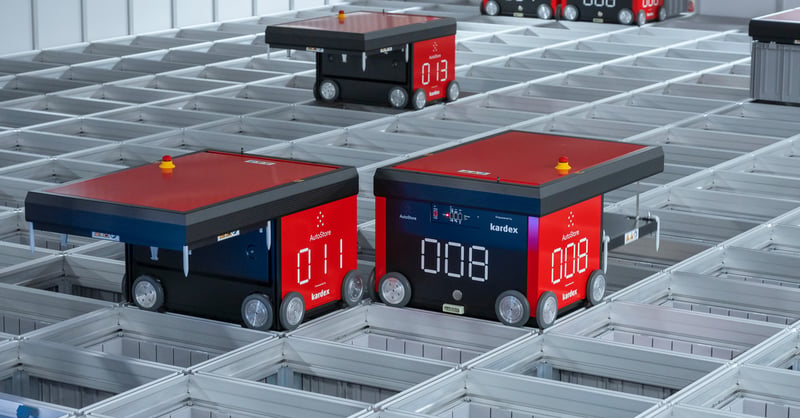
- The system stores products inside a compact grid where autonomous robots retrieve inventory bins and deliver them directly to operators at ergonomic picking stations. This goods-to-person approach significantly reduces operator travel while improving picking efficiency and order accuracy.
- Kardex worked closely with Douglas throughout the planning and design process, using operational data and growth forecasts to configure a solution capable of supporting both current and future requirements.
- The AutoStore system currently handles 1,200 of the facility’s 1,400 SKUs and processes approximately 92% of the warehouse’s 3,000 daily order lines.
-
- Improving warehouse performance
-
Following implementation, Douglas achieved significant operational improvements across storage, picking, and fulfilment operations.
-
One of the most immediate benefits came from the system’s compact footprint. AutoStore occupies only 10% of the warehouse space while increasing total storage capacity by 30%, allowing Douglas to expand operations without constructing additional warehouse space or relocating facilities.
-
The goods-to-person workflow also dramatically improved picking efficiency. Picking throughput increased from 50 order lines per hour to 200 order lines per hour, while operational throughput from order receipt to dispatch improved by 68%.
- Additional operational benefits included:
- 25% improvement in order cycle time
- 99.9% picking accuracy
- Improved inventory visibility and traceability
- Reduced physical strain on warehouse employees
- Minimal operational disruption during implementation
- The solution also provides long-term scalability, with the ability to add additional robots and ports as future demand grows.
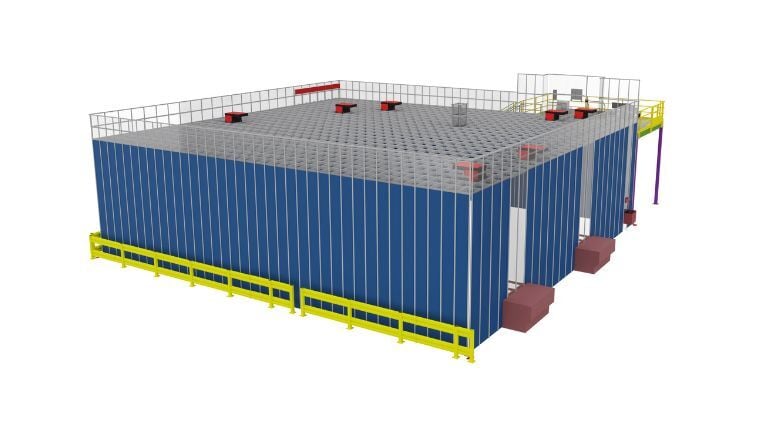
- Compact, scalable design
- The AutoStore system provides Douglas with a scalable automation platform designed to support future business growth.
- By storing inventory vertically inside a high-density grid, the system maximizes storage capacity within a minimal footprint while maintaining rapid access to inventory. Its modular design allows the operation to scale over time through the addition of robots, ports, or storage bins without major facility modifications.
- This flexibility enables Douglas to continue growing its operations while maintaining fulfilment performance, operational reliability, and warehouse efficiency inside its existing Auckland facility.
- Scope of delivery
-
Component Specification / Quality AutoStore Grid High-density grid supporting 6,300+ storage bins Robots 13 AutoStore robots Workstations 3 CarouselPorts and 1 ConveyorPort Storage Capacity 30% increase in total storage capacity Throughput x4 with 200 order lines picked per hour Facility Footprint 30% More Storage Within Just 10% of the Warehouse Footprint Commissioned 2025 - Supporting long-term growth
-
The implementation of AutoStore empowered by Kardex has enabled Douglas Pharmaceuticals to modernize warehouse operations while future-proofing fulfilment capabilities for continued growth.
-
By combining high-density automated storage, goods-to-person workflows, and scalable system architecture, Douglas now operates with improved efficiency, accuracy, and operational control while maintaining its existing warehouse footprint.
- The results?
- Faster picking performance
Picking performance increased from 50 to 200 order lines per hour
Increased storage capacity
30% more storage capacity within the existing facility
Optimized operational throughput
Small-parts storage consolidated into a compact automated grid
Enhanced inventory accuracy
99.9% picking accuracy with improved traceability
- Future scalability
Modular system design supports future expansion