
Go Back to Main Case Study Page
|
Storage Capacity |
Picking Efficiency |
Urgent Order Fulfillment |
| 20,852 storage Bins are now stored within 5,600 sqft. | The AutoStore system supports 3,648 picking lines per day and 751 put-away lines per day. | The system was modeled around urgent demand, with urgent orders treated as dedicated priority. |
Case at a Glance
Warren CAT implemented an AutoStore™ goods-to-person system empowered by Kardex at its Store 05 facility in Midland, Texas, creating a high-density parts fulfillment environment designed around dealer service demand.
As one of the largest Caterpillar® dealers in North America, Warren CAT supports customers across West Texas and Oklahoma with the parts and service availability required to keep heavy equipment moving. At its new Midland facility, the company needed to support a complex parts profile, urgent customer demand, and multiple order flows including Will Call, Parts Shuttle, Engine Shop, and customer orders.
With Kardex, Warren CAT created a more compact, controlled, and scalable approach to parts fulfillment. The solution helps reduce manual travel, improve storage density, support priority-driven order processing, and give the operation greater flexibility as parts volumes and service expectations continue to grow.
Customer and Task
Warren CAT’s Store 05 facility in Midland, Texas brings together a storefront, engine shop, and warehouse for parts storage and distribution. As parts volumes and SKU complexity grew, Warren CAT needed a denser, more controlled way to store and process inventory while supporting urgent dealer order flows including Will Call, Parts Shuttle, Engine Shop, and customer orders.
Solution
Warren CAT partnered with Kardex to implement an AutoStore™ goods-to-person system for high- density parts storage and retrieval. Kardex empowered the solution through automation design, implementation, installation, commissioning, training, documentation, and FulfillX warehouse execution software. The system stores eligible parts in a compact grid where robots deliver bins directly to operators. FulfillX supports AutoStore workflows including put-away, inventory management, order allocation, and picking, helping Warren CAT reduce manual movement and support priority-based fulfillment.
Dealer parts operations are different
Warren CAT’s parts operation is not a typical small-parts warehouse. It supports a dealer service model where parts availability can directly affect technician productivity, customer wait time, and equipment uptime.
The Midland facility was designed to support several different parts flows under one roof. Will Call orders may need to be available when customers arrive. Parts Shuttle demand supports movement across the broader dealer network. Engine Shop orders require fast access to support service work. Customer orders need to move through the warehouse with accuracy and consistency.
That mix of demand created a clear operational challenge: Warren CAT needed to store more parts in less space while also improving how work was prioritized and executed. The goal was not simply to automate storage. The goal was to create a fulfillment process that could respond to dealer demand with more structure, visibility, and control.
Kardex and Warren CAT approached the project with this operating reality in mind. The AutoStore system needed to support dense storage, but it also needed to support the way dealer parts work actually happens: by order type, priority, urgency, and destination.

Designing around real order data
Before the system was finalized, Kardex analyzed Warren CAT’s historical order and product data to understand the scale, variability, and growth requirements of the operation.
The dataset included more than 93,000 orders, nearly 300,000 order lines, and almost 25,000 products. This analysis helped define the storage and throughput requirements for the AutoStore system, including average and peak-day demand.
The data showed that Warren CAT needed a system that could handle daily variability and future growth. The AutoStore design was sized for Year 5 inbound and outbound volumes, with the ability to support 3,648 picking lines per day and 751 put-away lines per day. The system was also modeled around urgent demand, with urgent orders treated as a dedicated priority category.
This data-driven approach helped ensure the system was not just sized for current volume. It was designed to support a growing dealer parts operation with changing demand patterns, peak-day pressure, and a broad SKU profile.

Compact storage for a complex parts profile
Warren CAT’s Midland operation required a storage model that could support a large eligible inventory base without consuming unnecessary warehouse space.
The AutoStore system consolidates parts into a compact, high-density grid with 20,852 net storage bins in approximately 5,600 square feet, including ports and service mezzanine. The design includes 20 AutoStore robots, three carousel ports for outbound picking, and two conveyor ports for inbound processing.
This density is especially valuable for dealer parts operations, where thousands of small parts must remain accessible while the overall inventory profile continues to grow. AutoStore’s vertical cube utilization allows Warren CAT to store eligible parts in a smaller footprint than traditional shelving, drawer-based storage, or racking approaches.
The system also provides flexibility for future expansion. Additional robots and ports can be added independently, and the design allows for future storage and throughput growth with minimal interruption to daily operations.
Bringing parts to the point of work
With the AutoStore system empowered by Kardex, Warren CAT moved from a manual travel-based process toward a goods-to-person workflow.
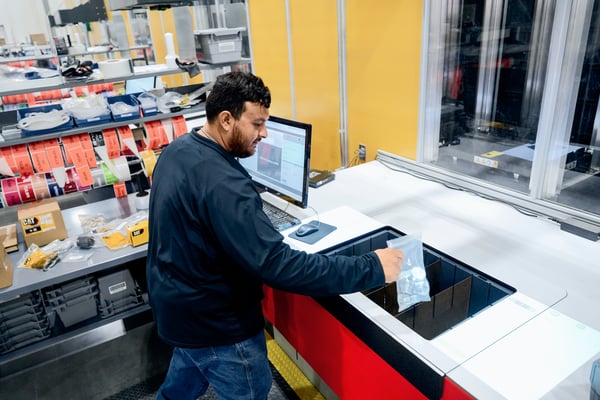
Instead of operators walking the warehouse to search for and retrieve parts, AutoStore robots deliver storage bins directly to operator workstations. This shift reduces unnecessary movement and helps create a more consistent work environment.
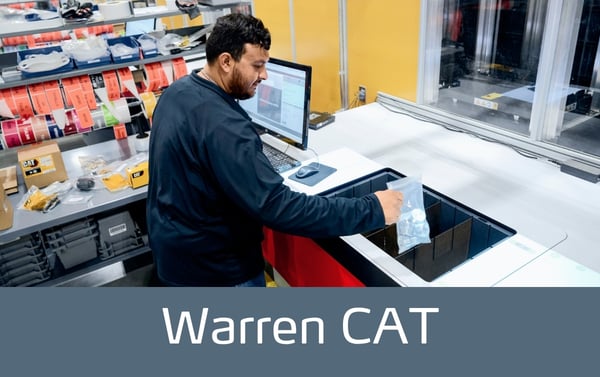
At outbound ports, operators pick parts from delivered bins and place them into order totes for downstream consolidation, packing, Will Call, Engine Shop, or other order destinations. At inbound ports, operators are guided through the put-away process as bins are delivered for storage.
This station-based approach changes the rhythm of the warehouse. Work is brought to the operator, rather than the operator moving across the facility to find the work. For Warren CAT, that creates a cleaner, quieter, and more controlled environment for daily parts fulfillment.

Kardex connects automation to execution
Kardex FulfillX provides the warehouse execution layer between Warren CAT’s host warehouse system and the AutoStore automation. Its role is to manage the work taking place inside the automated environment while allowing Warren CAT’s existing systems to remain the source of record.
For outbound processing, Warren CAT’s host system sends customer orders to FulfillX. FulfillX sorts orders by category, due date, and priority, creates AutoStore tasks, and sends prioritized work to the AutoStore control system. Ports can be configured to support specific order types, such as Will Call, Parts Shuttle, or Engine Shop demand.
In Warren CAT’s environment, FulfillX also demonstrated the value of flexible integration. The system connected with FDC WMSv2, a warehouse management platform used in Cat dealer operations, helping bridge dealer-specific warehouse workflows with AutoStore execution. This gives the project broader relevance: automation can be introduced into an existing WMS environment without replacing the system of record or creating a disconnected automation island.
This is where the solution becomes more than dense storage. FulfillX helps translate warehouse priorities into automation execution, giving Warren CAT a more structured way to manage urgent work, multiple order types, and daily fulfillment demand.
Immediate impact on the warehouse floor
Soon after go-live, Warren CAT began seeing the practical impact of goods-to-person automation in daily operations.
The most visible benefit was storage density. AutoStore’s vertical cube utilization created a meaningful space advantage compared with traditional shelving and drawer-based storage. By consolidating eligible parts into the automated grid, Warren CAT gained a more compact storage model for a complex parts environment.
The operating environment also changed. With less cart movement, less traffic, and more work centered at dedicated stations, the AutoStore area became cleaner, quieter, and more controlled. Operators spend less time traveling across the warehouse and more time working from stations where parts are delivered directly to them.
The system is live and supporting daily work, with parts being stored, picked, and processed through the new environment. As Warren CAT continues to refine workflows and build operating maturity, the immediate value is clear: the automation is already helping the team create a denser, more structured, and more controlled parts fulfillment process.

Immediate value. Long-term growth.
Warren CAT’s Midland implementation shows how Cat dealer parts operations can use automation to address immediate warehouse pressure while building a foundation for future performance.
By implementing an AutoStore goods-to-person system empowered by Kardex, Warren CAT created a more controlled environment for storing, picking, and processing parts. The system supports dense storage, reduced operator travel, priority-based order execution, and scalable growth.
The project also reflects an important reality of automation: the strongest results come when hardware, software, process, and operations work together. Kardex supported Warren CAT with the equipment, project execution, implementation expertise, and software needed to bring the automated environment into daily operation.
Warren CAT is continuing to refine workflows and build operating maturity, but the
core value proposition is already visible on the warehouse floor.
Scope of delivery
| Component | Specification/Quantity |
|---|---|
| AutoStore Grid | High-density grid supporting 20,852 Bins |
| Robots | 20 AutoStore R5 Robots |
| Workstations | 3 CarouselPorts, 2 Narrow ConveyorPorts, 2 future CarouselPort frames |
| Software | Kardex FulfillX WES for order orchestration and system control |
| Integration | Full ERP integration with FDC WMSv2 |
| Kardex Scope | System design, project engineering, installation, commissioning, testing, training, and documentation |
| Primary Workflows | Inbound put-away, inventory management, order allocation, outbound picking |
| Order Types Supported | Will Call, Parts Shuttle, Engine Shop, and other prioritized order flows |
| Commissioned | 2026 |
Are You Ready to Eliminate Fulfillment Bottlenecks?
Kardex helps organizations optimize fulfillment performance through intelligent automation, high-density storage, and software-driven workflow orchestration tailored to their operational needs.
Schedule an Operational Assessment:
Connect with a Kardex automation specialist to evaluate your current fulfillment operation, identify bottlenecks, and uncover opportunities to improve throughput, storage density, labor efficiency, and order responsiveness.